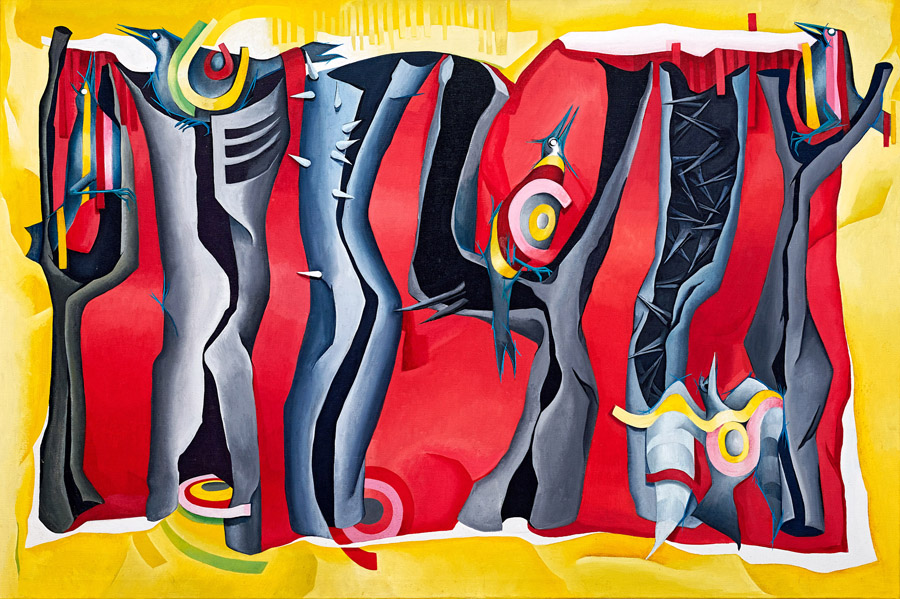
Target Composition I ,
Provenienza :
Exhibited : Pretoria Art Museum, Pretoria, Cecily Sash Retrospective 1954-1974, catalogue number 91, illustrated in colour in the catalogue centrefold
Literature :
Note : Greatly admired as a pioneering artist and teacher, Delmas-born Cecily Sash was trained by Maurice van Essche in Johannesburg and Victor Passmore in London. A founding member of art dealer Egon Guenther’s Amadlozi Group of artists, in 1965 she spent a year studying art education in Britain and the United States, notably interviewing abstract painter and teacher Josef Albers.1 On her return to Johannesburg, where she taught design at the University of the Witwatersrand, Sash became a committed proponent of hard-edged abstraction in painting. In a 1968 interview with Robert Hodgins, Sash rationalised her internationalism as follows: “What we must be careful of is not to be afraid of our borrowings. I think myself that there is a sort of over-anxious desire for national art in this country.”2 Sash’s commitment to pure abstraction was however short-lived. In the early 1970s, she returned to figurative subjects, notably the bird.
An enduring motif in her work, Sash began depicting birds in 1955 after a dove flew into the art room where she gave classes at Jeppe Girls’ High.3 This work forms part of a series known as Bird and Target (1973-74). Sash here integrates the vibrant palette and linear styling of her earlier hard-edged abstractions into a self-described “metaphysical” painting that visualises her personal crisis – she emigrated to England in 1974 due to this country’s segregationist politics. “The target was on the bird originally as a decorative device which derived from my tapestry designs in 1973,” explained Sash, adding that here it however served as “a symbol of destruction”.4 Esmé Berman has remarked on the dual role of the avian symbols in this body of work: “concurrently victims and aggressors, their weapons are their vicious claws and beaks, but their wings have been replaced by brightly coloured targets”.5 Sash recognised this ambiguity: she has described her target-festooned birds as both “monumental and vulnerable.”6
1. Sash interviewed Albers in December 1965, transcript in the archives of the Josef and Anni Albers Foundation.2. Hodgins, Robert, ‘South African Art: Has it Made it?’, News/Check, 20 December 1968, page 163. Harmsen, Frieda. (1985) Looking at South African Art, Pretoria: JL van Schaik. Page 334. Sash, Cecily. (1999) Working Years, Presteigne: Studio Sash. Page 445. Berman, Esmé. (1993) Painting in South Africa, Johannesburg: Southern Book Publishers. Page 272.6. Sash, op.cit., page 45
Condition_report :