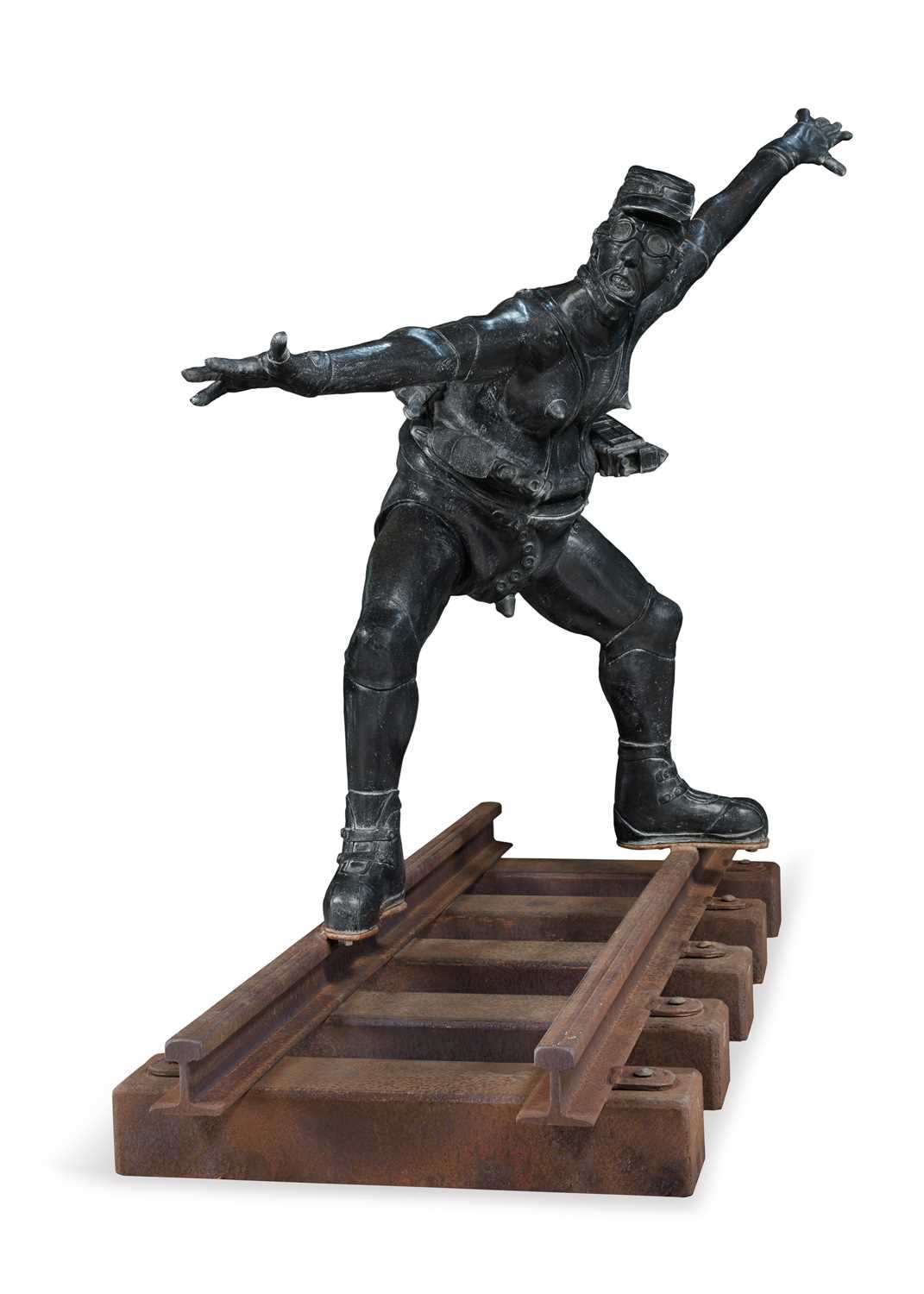
Engine Driver (From The Deadly Sinners Series) ,2011
Provenienza :
Exhibited :
Literature :
Note : David Brown was a dedicated artistic satirist and masterful sculptor. His sculptures, especially his large-scale works in wood and metal, are representative of a certain type of ironically oppositional narrative within South African art from the height of apartheid. Brown was quite specific about the anti-apartheid, political protest nature of his work, and in the regime’s aftermath, his work moved into a more generalised satirical view. Brown typically brought a macabre, even Hogarthian humour to his figures, along with their hints of grotesquerie and chimera, all set in an implicitly political context. Engine Driver, a large-scale work from 2008, is a version of one of the figures which appear in the 2011 series, Deadly Sinners. Brown is said to have been influenced in creating the work by reading a book on the gulags in Stalinist Russia, which led him to muse on the role played by ordinary people in facilitating social horrors – what Hannah Arendt called ‘the banality of evil’.
The notion of forced removal and imprisonment inherent in the image of the gulag train of course has echoes in the forced removals of the apartheid era. Brown would go on to imagine a range of such figures that, in his view, caused a range of social ills and evils. The ‘deadly sinners’, made at a much smaller scale than this work, included a preacher, a surgeon, a hunter and a butcher. Each is characterised by an exaggerated pose and appendages from their role in life attached to their person or sculpted as the base for the figure. In the case of the large-scale standalone engine driver figure, this life-size lampoon is sculpted in a classic surfer’s pose, literally riding the rails, which, complete with steel sleepers, forms the base of the imposing work. As with many of Brown’s satirical male figures, the engine driver, clad only in shorts and boots, is shown with a protruding penis sticking out of his shorts. The abandonment and speed of the driver riding the rails, his locomotive and carriages in miniature chasing around his waist, is admirably realised. While there is much comedy here, there is also a sinister undertone that was common in much of Brown’s later figures, a barbed comment on what we would now call ‘toxic masculinity’.
James Sey
Condition_report :