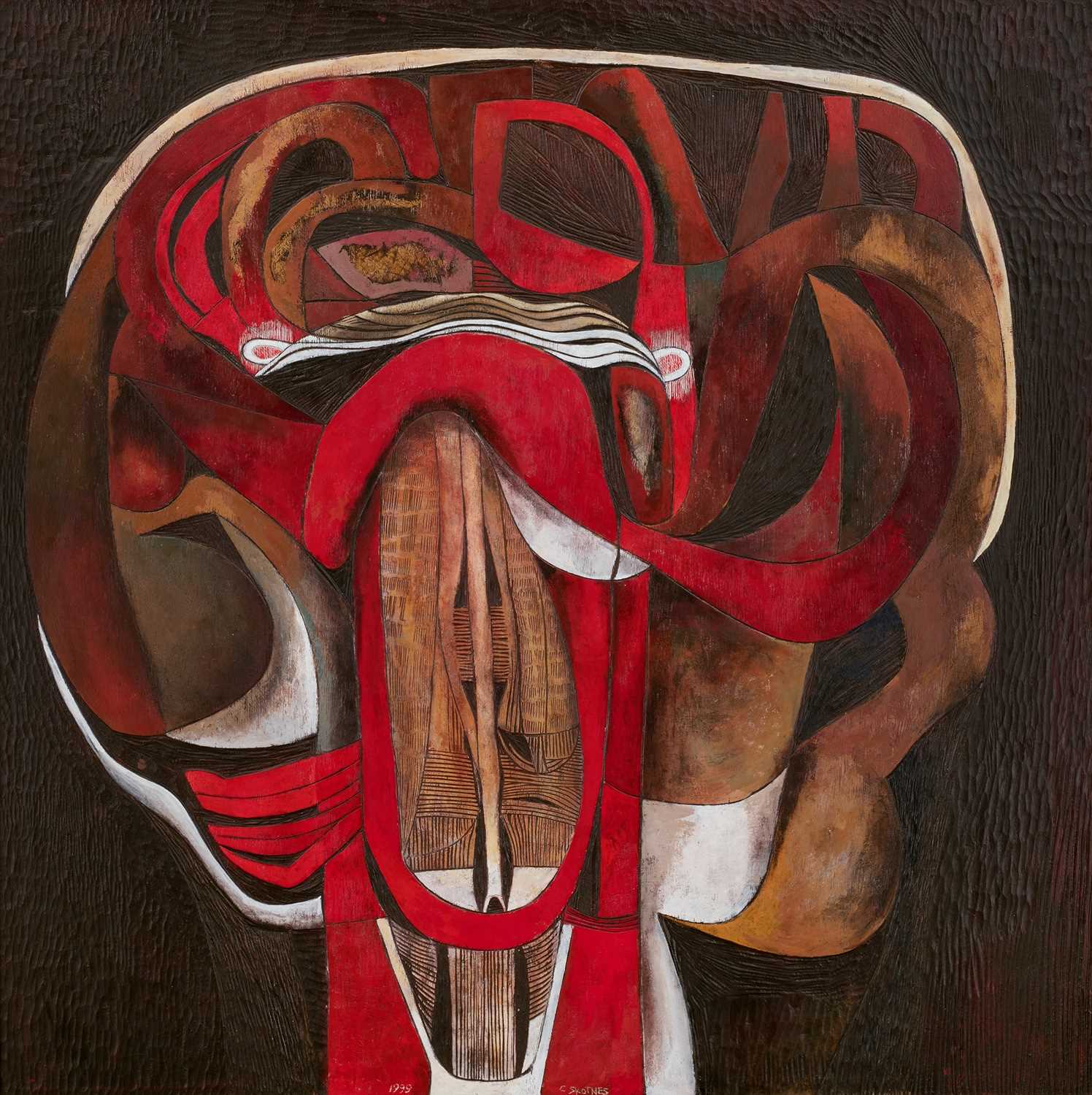
Ravine Wall ,1999
Provenance :
Exhibited : Lipschitz Gallery, Cape Town, in collaboration with Goodman Gallery, Johannesburg, Artery, 29 November 1999 to 15 January 2010.
Literature :
Notes : Landscape and mindscape intertwine in this starkly totemic, semi-abstract work by Cecil Skotnes. Elemental colours of earth, fire, pelt, bark, blood and stone combine with striations of carved wood to impart a direct archetypal connection to the fundamental pigments and material of the natural world. In its unequivocal boldness of colour and intensity of line, this carved and painted headscape emits a trance-inducing energy. Transcendental states of consciousness were familiar territory for the son of an ordained Lutheran minister and missionary and an active member of the Salvation Army; this is where the work happens. Skotnes was very close to his Norwegian father, from whom he inherited his intense interest in history, particularly ancient history, and in time, the subliminal messages coded into the art of bygone peoples – Egyptian, Babylonian, Beninnoise, Assyrian, pre-classical Greek, sub-Saharan African – would be assimilated into his work. This head knows no one tribe. Outside of terrestrial time and allegiance, it transmits a geological energy. In its wavelike horizontality, one abstract shape evokes a corpse; another a chrysalis. Within the topography of the head, one detects cave-like chambers and recesses. Yet, it is also strangely human, the familiar spinal column rising upwards vertically, supporting life and psyche. Some of the shapes bear a resemblance to the letters of the alphabet – signalling linguistic faculty, the foundation of human personality. The arcane head as metaphysical landscape is a recurrent theme that stretches across Skotnes’ oeuvre. ‘The key here is the concept of landscape in its broadest sense, of the landscapes of the mind, of an artist’s mindscape, and above all, of the the link between landscape and memory,’ writes Neville Dubow (1996:121). ‘All of Skotnes’ work may be seen in these terms, as built from strata of memory, either from real experience or imagined experience; as landscapes of the mind at the point where the physical and metaphysical intersect. Physically, in material terms, his carved panels are landscapes of a kind, with their own ridges and peaks, valleys and plains… But if you analyse these you find that they, too, are layered, literally and metaphorically. They have their own archaeology. It is an archaeology of association’ (Harmsen 1996: ??).
Alexandra Dodd
Condition_report :