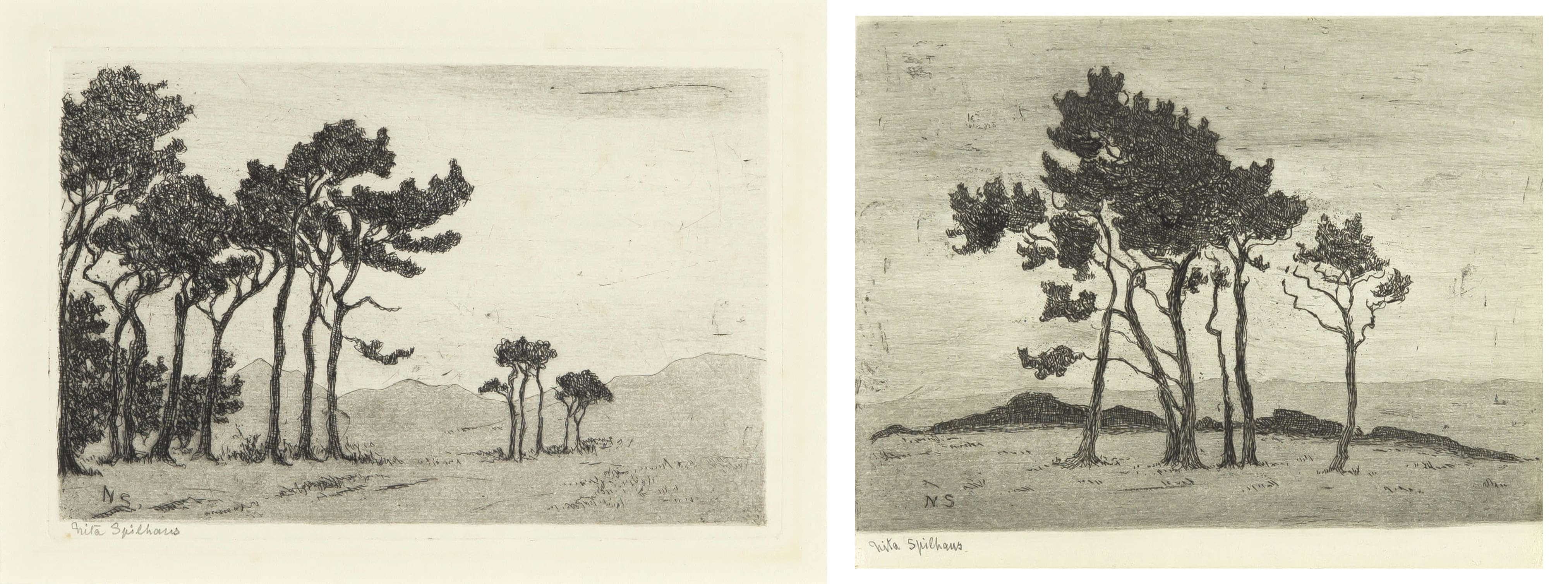
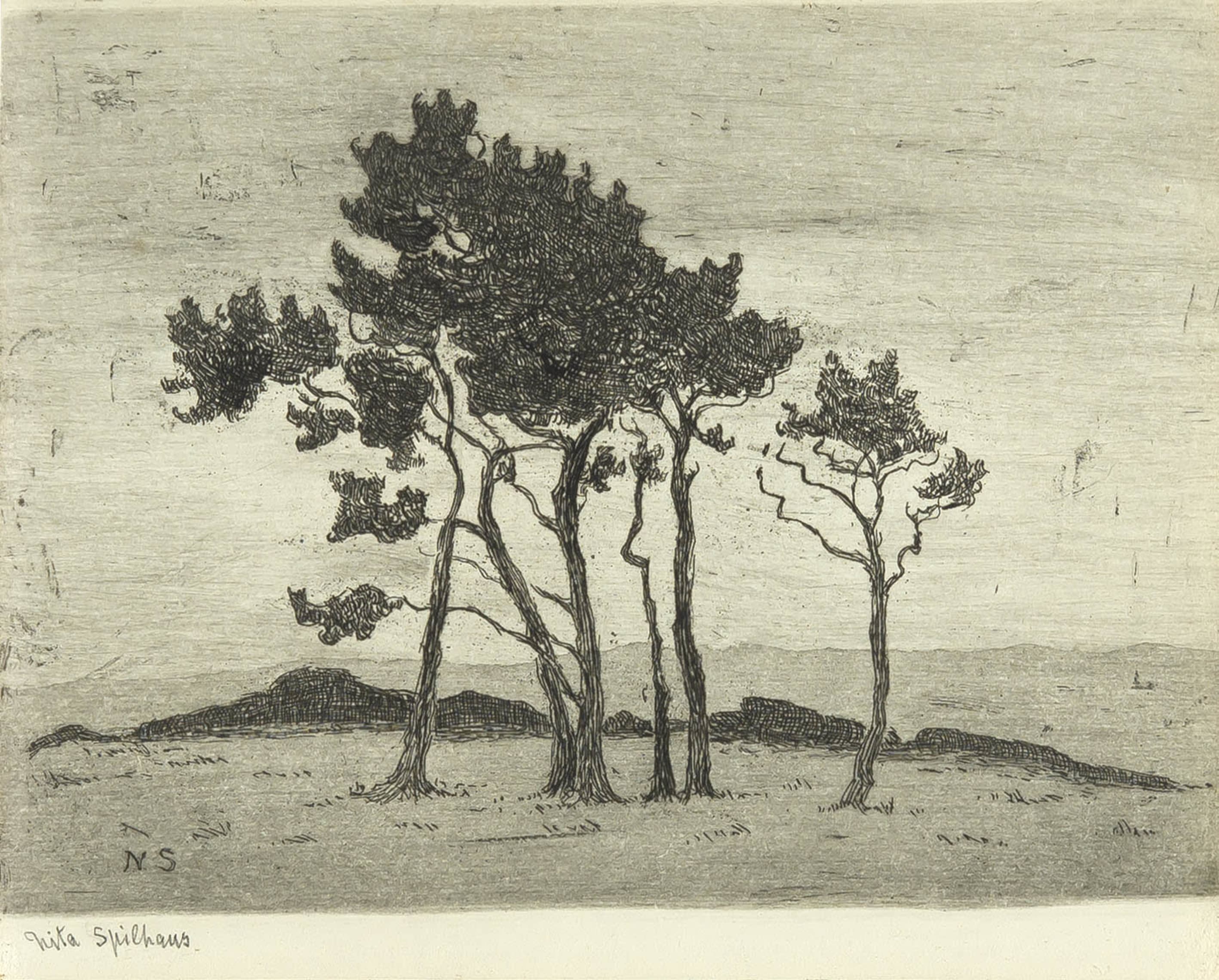
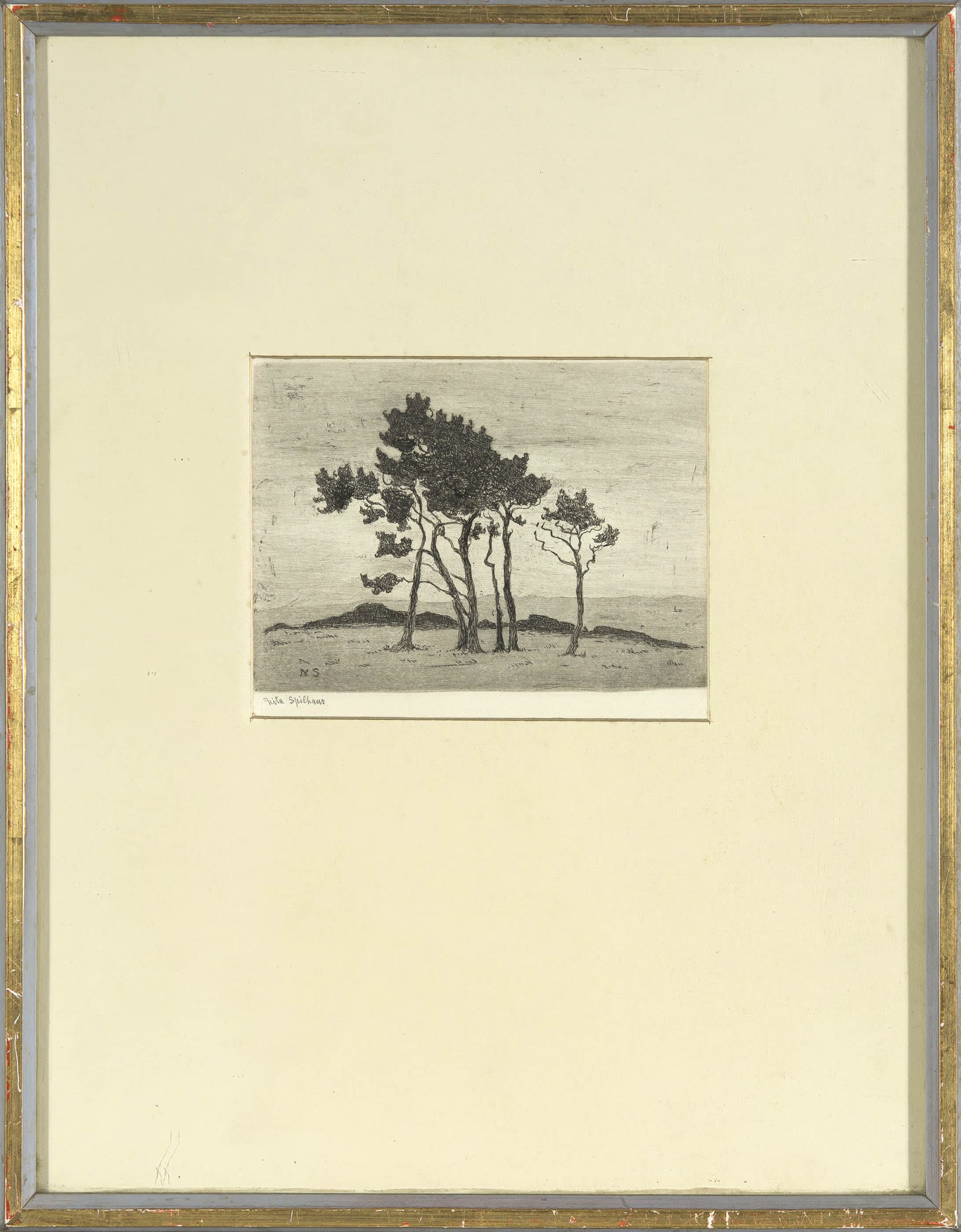
Pine Trees, Two
Provenance : [Propriété non datée]
- Dr Matthys Johannes Strydom Family Collection
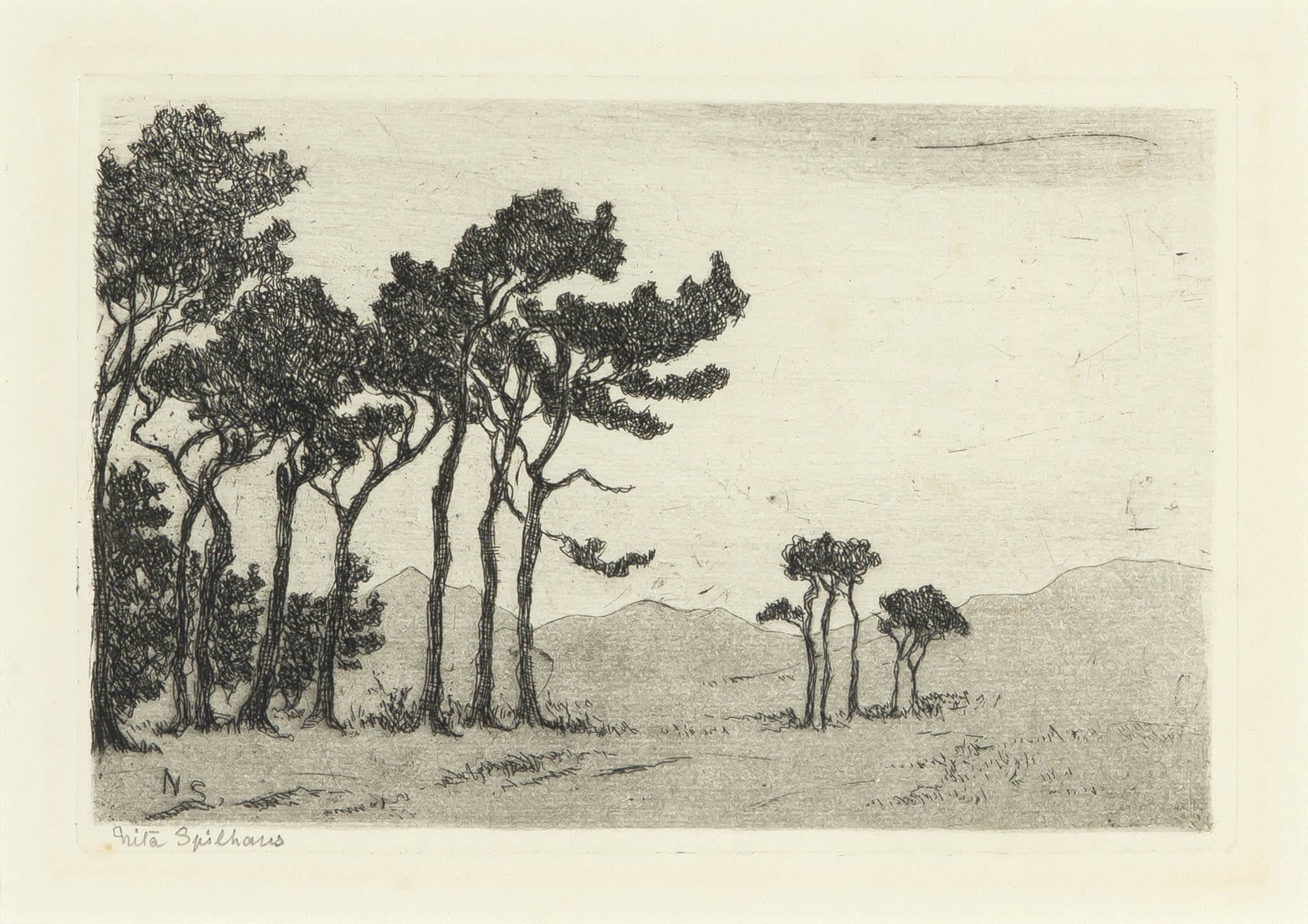
Notes : Looking at Nita Spilhaus’ oeuvre trees are her dominant subject matter and convey a sense of soft yet confident grandeur. In Lonely Trees (lot 254) Spilhaus expresses majesty and strength in the strong stone pines she has painted. The branches are thick, revealing their age with their fissured bark. Stone pines are a particular favourite for Spilhaus, and she painted many scenes with them in various groupings, often rendering them reaching to touch the mountain tops and soft evening skies. It is interesting to note that stone pines are not indigenous. They were brought here by the Huguenot refugees that settled at the Cape, who grew them from seeds collected in their native France. Spilhaus found all trees intriguing, disallowing her to be restricted to her favourite stone pines. “Old gnarled trees, fresh young saplings, oaks and firs all fascinated her.”1 Upon reviewing Nita Spilhaus’ exhibition at Martin Melck House Galleries in December 1963, the critic, Andre Cilliers, noted of her tree paintings that “Each one is an individual portrait of a particular tree. She understands its growth and the conditions that made it the tree it is. Even her slight sketches of trees make one aware that trees don’t just happen, but that every one has a history.”2 In general, Spilhaus preferred relaxed compositions and a realistic palette. The application of paint is clearly visible. Palette knife and brushstrokes contribute significantly to the visual interest of her pictures. Celebrated South African Art Historian Frieda Harmsen observes of Spilhaus’ work, “The seductive quality of the paint above all else is the subject of her artwork, the motif being the mere carrier of the painting.”3 Spilhaus sought for a greater effect than texture and colour alone could provide, she endeavoured to introduce clearly defined shapes and sufficient contrasts in tone to provide both constructive and formal clarity.4 Nita Spilhaus’ contribution to South African art was her excellent technical ability, her romantic feeling towards a scene, and her fundamental sincerity, honesty and respect for the essentialcharacter of a subject.5 1. Magda Sauer (n.d.) 'Nita Spilhaus' in Our Art, Pretoria: Lantern and The S. A. Broadcasting Corporation, page 127.2. Andre Cilliers, Cape Times, 11 December 1963.3. Freda Harmsen (1985) Looking at South African Art, Pretoria: Van Schaik, page 44.4. Ibid, page 212.5. Sauer, 128.Peter Elliott (2015) Nita Spilhaus (1878 – 1967),Cape Town: Peter Elliott.