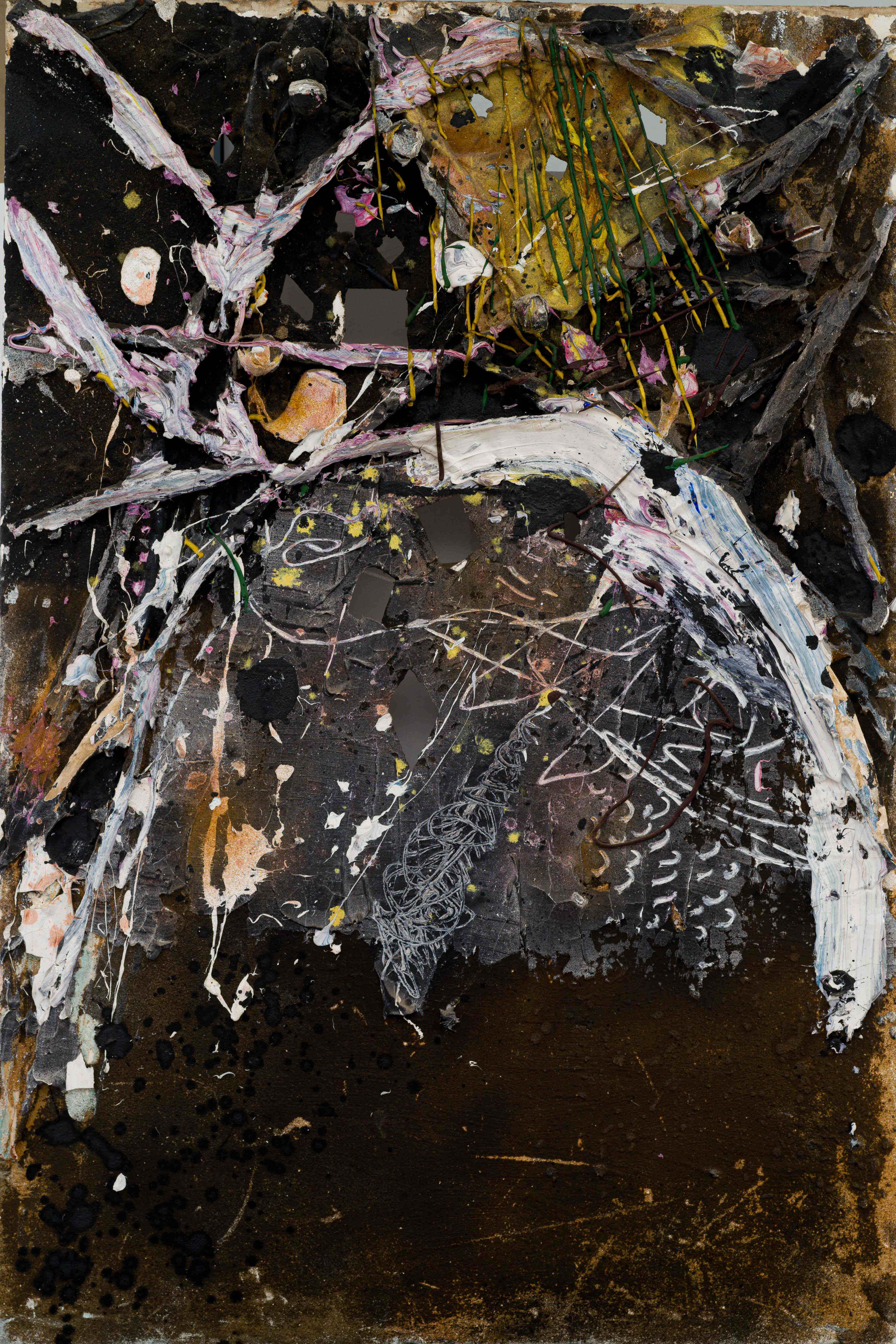
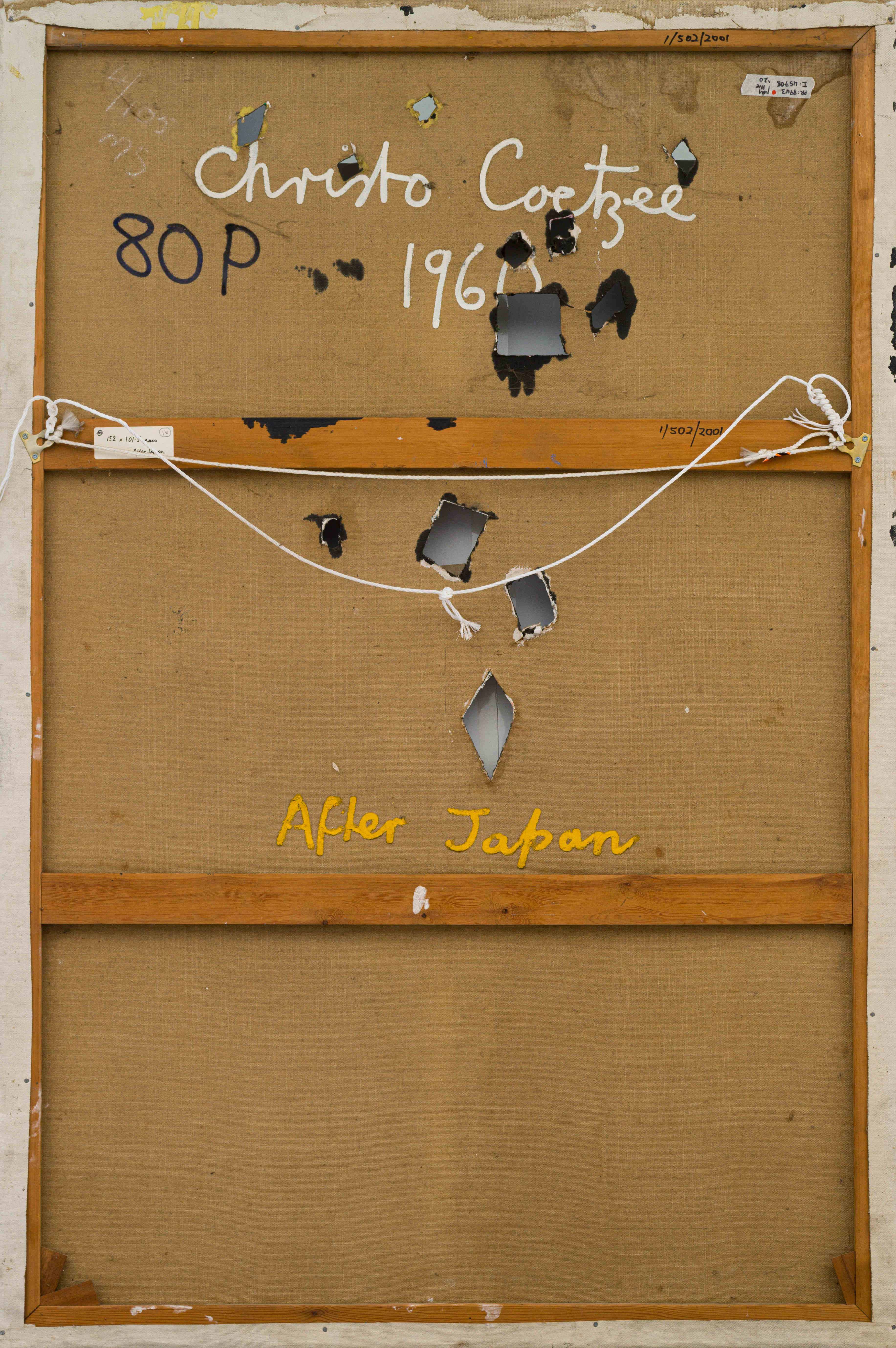
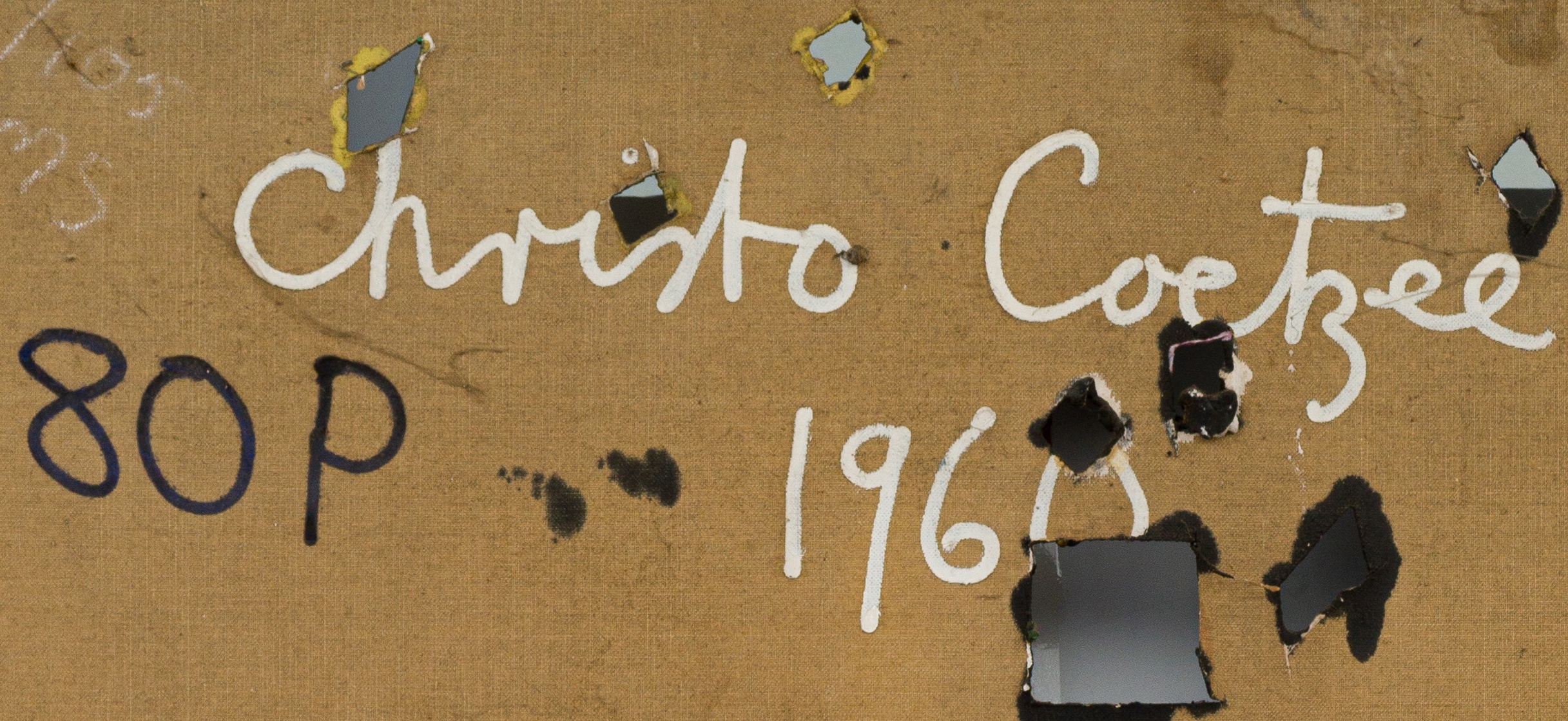
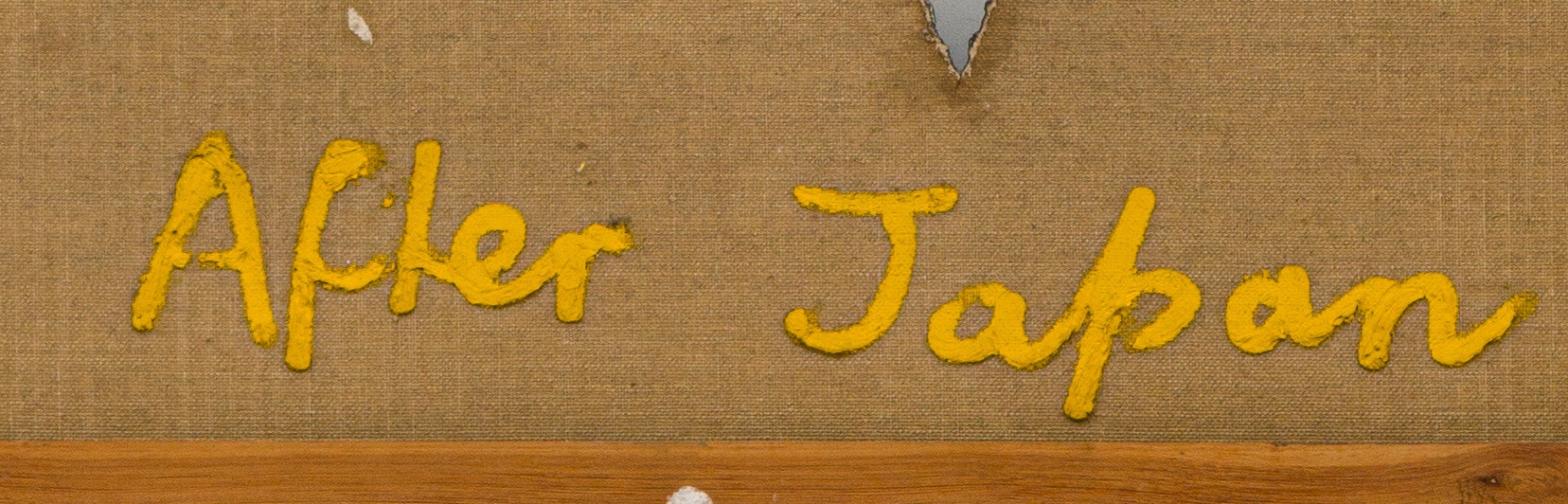
After Japan ,1960
Provenance :
Exhibited : Galerie Stadler, Paris, Christo Coetzee, solo exhibition, September 1961.
Irma Stern Museum, Cape Town, Christo Coetzee: Paintings from London and Paris: 1954 – 1964, 20 September to 13 October 2001.
Sandton Art Gallery, Johannesburg Christo Coetzee: Paintings from London and Paris: 1954 – 1964, 24 October to 17 November 2001.
Standard Bank Gallery, Johannesburg, The Safest Place is the Knife’s Edge: Christo Coetzee (1929 – 2000), 5 October to 1 December 2018.
Literature : Michael Stevenson andDean Viljoen (2001) Christo Coetzee: Paintings from London and Paris: 1954 – 1964, Cape Town: Fernwood Press, illustrated in colour on page 39.
Wilhelm van Rensburg (2018) The Safest Place is the Knife’s Edge: Christo Coetzee (1929 – 2000), Johannesburg: Standard Bank Gallery, illustrated in colour on page 68.
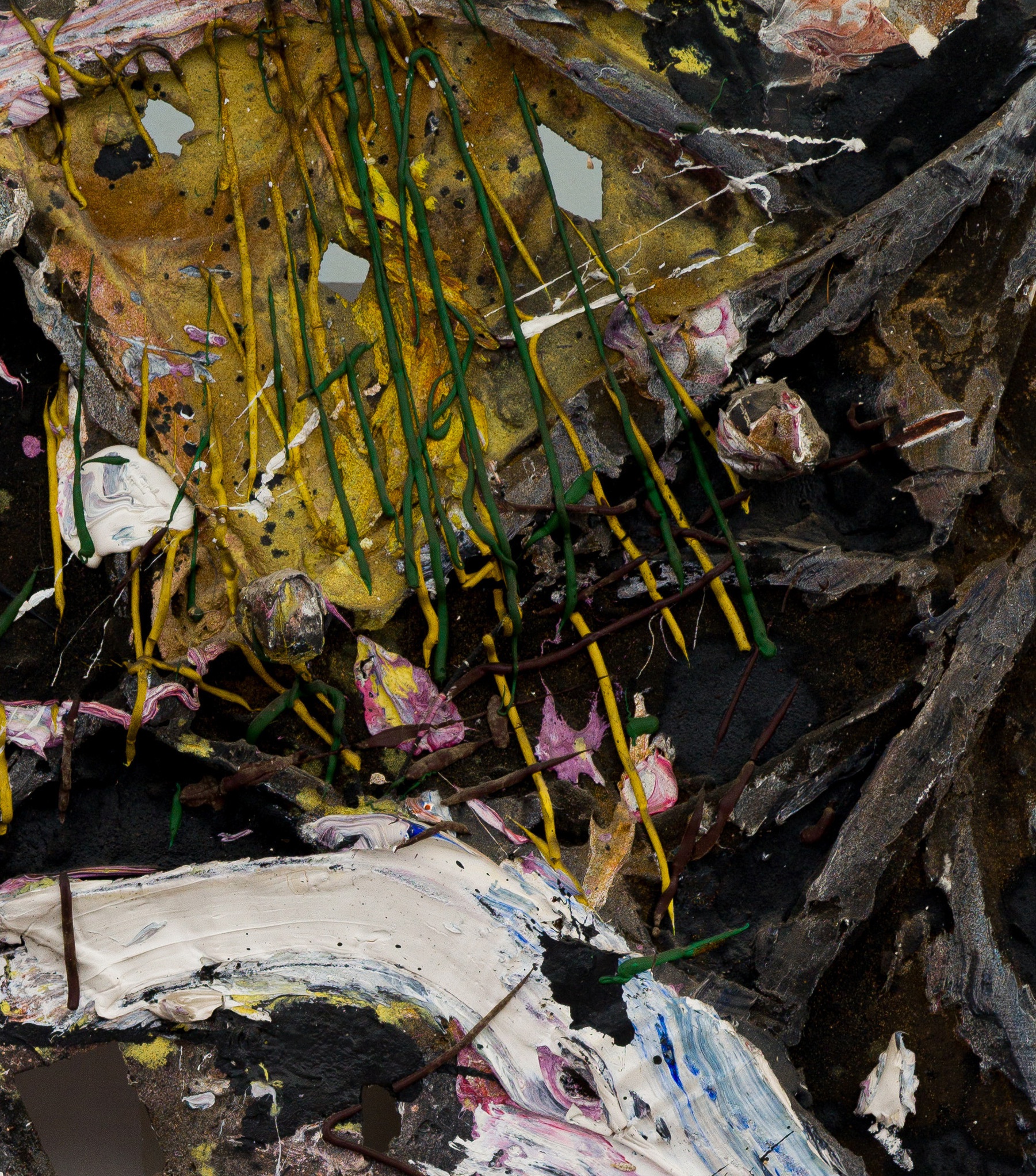
Notes : The present lot, After Japan, is arguably one of the most important works Christo Coetzee painted after his sojourn in that country, and speaks of his close association there with the Gutai group of post-war avant-garde artists in 1959/60. This work is essentially a synthesis of Coetzee’s indefatigable search for innovation in his artistic practice. Back in Paris, he drew on the theories of Michel Tapié de Celeyran, who coined the terms Art Autre and l’Art Informel to describe European abstract expressionism of the late-1950s, as well as on his own experience of the materiality of the paint medium he learned from the Gutai artists. The thick paint and gestural nature of the brush strokes in the present lot attest to this vigorous physical embodiment of the medium. However, Jiro Yoshihara, the founder of the Gutai, argues that Christo’s painting ‘which at a glance seems so baroque, is in effect motionless and still.’1 Reviewing the 1961 exhibition – Coetzee’s second at Galerie Stadler, the first with Lucio Fontana having been in 1959 – Francis King maintains that each of Coetzee’s non-representational works ‘has the quality of a bas-relief, time-eroded and weather-battered like carvings on a building. In his use of a medium which forces him to paint in depth, he seems to have found a boldness and even ferocity which make an infinitely more potent assault on the eye than the careful contrivances of his earlier period’.2 After Japan indeed constitutes a huge milestone in Coetzee’s long artistic career.
1. Michael Stevenson and Deon Viljoen (2001) Christo Coetzee: Paintings from London and Paris, 1954–1964, Cape Town: Fernwood Press, page 29.
2. Ibid, 27 and 28.