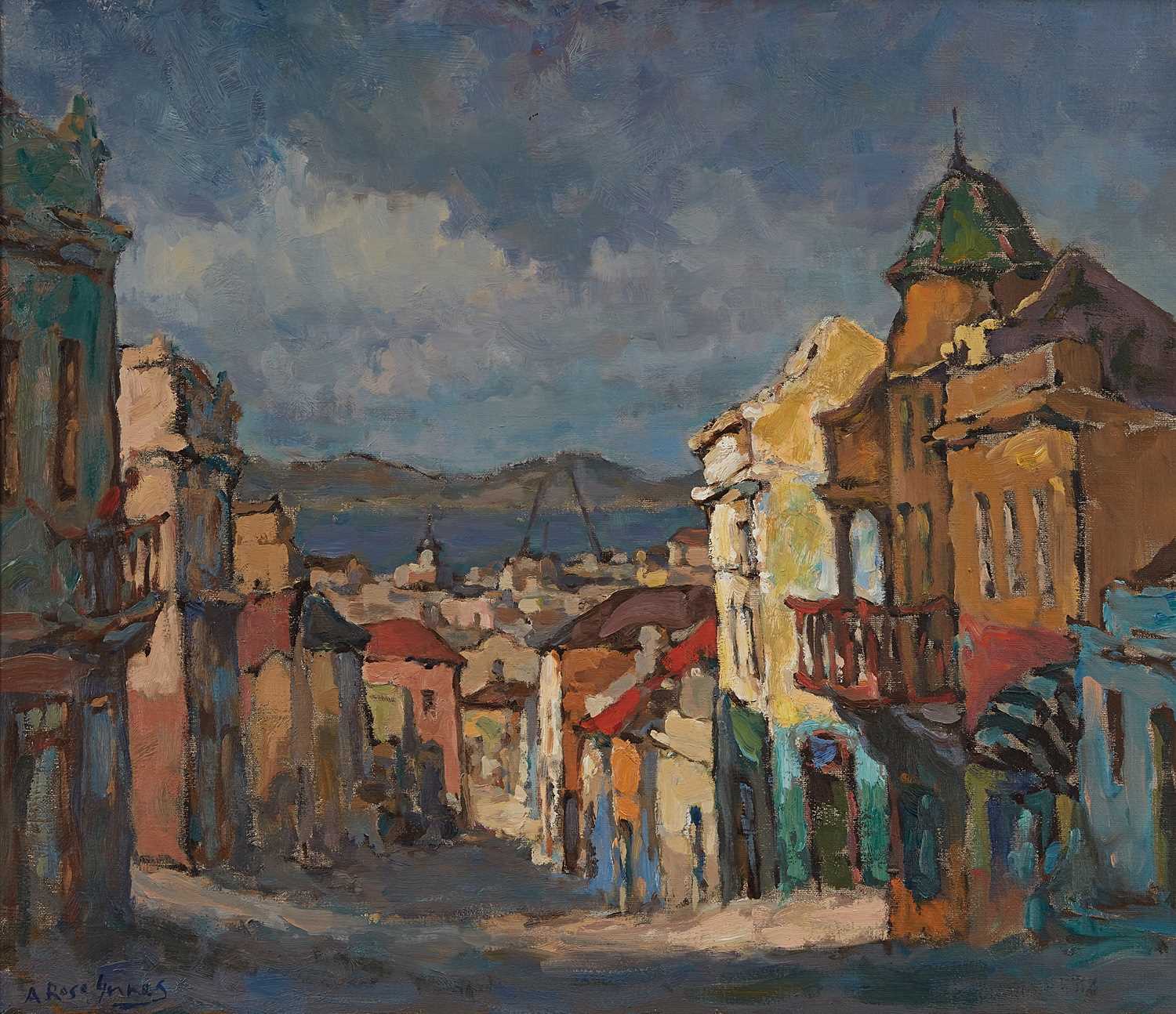
Tennant Street, District Six, Cape Town ,1962
Procedencia :
Exhibited :
Literature :
Notas : ‘Look down on District Six from some vantage point and the impression it gives is one of unity in diversity, a confused and disorganized abstraction of rusted roofs, turrets, minarets, towers, arches, ornate façades, colonnades and Gothic spires, dazzling in their variety and colour.’ This is how Cloete Breytenbach (1970:6) remembered this Cape Town neighbourhood in The Spirit of District Six in 1970, only two years after the removal of District Six inhabitants started in 1968. Looking down Hanover Street or possibly Tennant Street towards the bay Alexander Rose-Innes captured something of this ‘confused and disorganised abstraction’ in this painting, from a vantage point Gregoire Boonzaier shared in many of his renditions of this area.The architectural character dominates in this scarcely populated street scene – only a single man on a balcony and perhaps two or three figures to the right are visible. Embracing the buildings, some sunlit, are the street surface, the distant harbour and sea and the clouded sky, all rendered in shades of blue.
By the time Rose-Innes settled in Cape Town in 1956 the New Group with Boonzaier as chair and members like Lippy Lipshitz, Frieda Lock, Cecil Higgs and Terence McCaw had disbanded three years earlier. The Group had succeeded in its aim of bringing art within reach of a wider public by hosting lectures and exhibitions in Cape Town but also countrywide.It was in this well-established environment that Rose-Innes worked within the Cape Impressionist tradition, influenced by the major exponents of that idiom and particularly by Boonzaier, with whom he became close friends and whom he joined on several painting excursions.“Alexander Rose-Innes is a conservative artist. He did not pursue innovation for the sake of innovation; nor did he follow fashionable trends. Yet his particular brand of painting has not only survived, but steadily grown in popularity,” argues Martin Bekker (1991:37)What Rose-Innes captured of District Six in this image is what Breytenbach (1970:6) refers to as ‘a place of poverty and often degradation, but a place where people had the intelligence to take what life gave them and give it meaning’.
Johan Myburg
Condition_report :