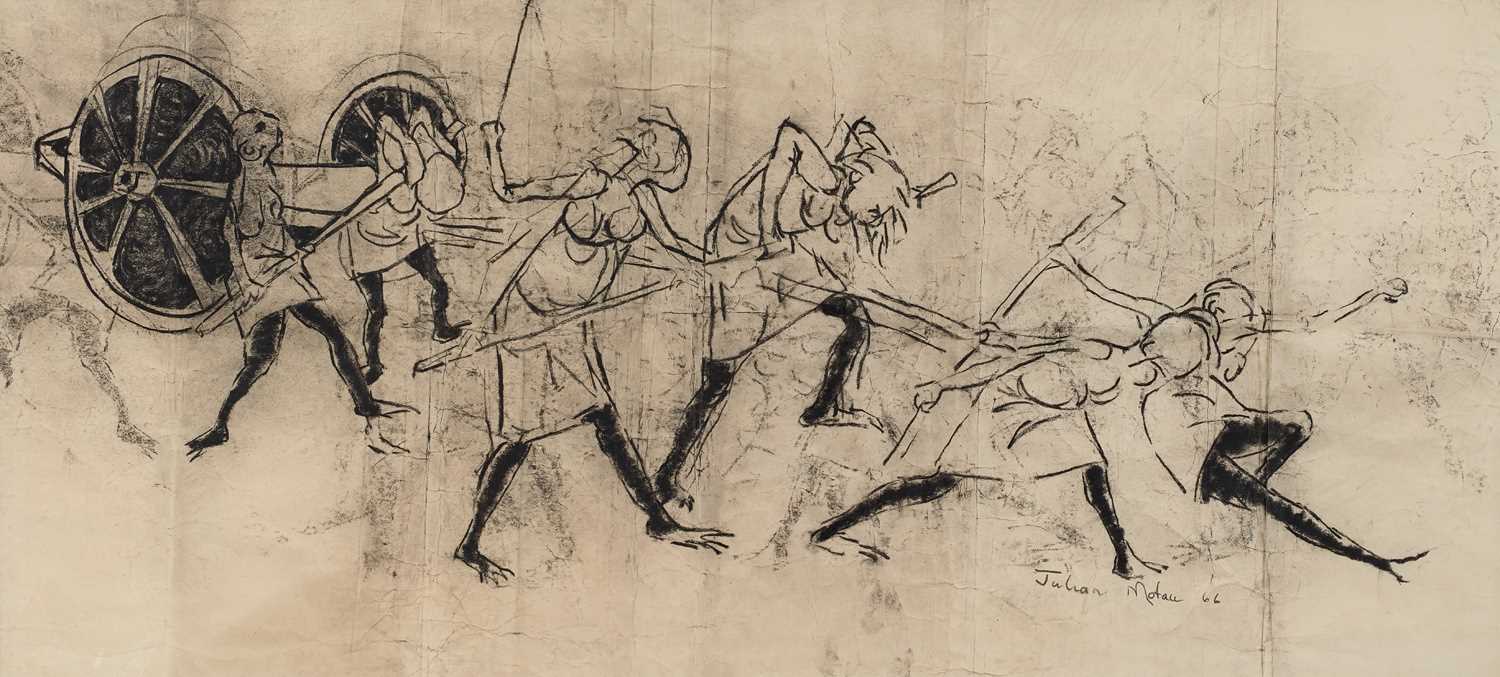
Apartheid Slave Wagon ,1966
Procedencia :
Exhibited : cf. A work of similar subject matter, History, by Dumile Feni, is in the collection of the Constitutional Court, Johannesburg.
Literature :
Notas : Julian Motau’s story is tragically typical of many young black artists trying to express their talent in the apartheid era. In many ways it is more tragic since his death aged only 20 robbed South African art history of his mature work. Born in a rural village near Tzaneen in Limpopo province, Motau moved to Johannesburg in 1963, still a teenager, with almost no formal education. His burning desire to draw and paint, and to learn about art practice, led him to discover art-world networks in the city. Through artist Judith Mason he met prominent gallerist Linda Givon, founder of the Goodman Gallery, who gave Motau his first one-person show in 1967, and remained close to the artist until his death.The artist’s frenetic expressionism and graphic energy has brought comparisons with Dumile Feni, an interesting counterpoint when both artists exhibited on the influential group show A Black Aesthetic at the Standard Bank Gallery earlier this year. Motau’s lack of development in technique and experience meant that he ranged widely in subject matter, though focused, in characteristically ‘angry young man’ style, on the consequences of apartheid poverty and degradation that he saw all around him. He often sketched from life in Alexandra township outside Johannesburg, where he lived.This singular work offers his kinetic vision of a slave wagon, pulled by dynamically sketched and tortured female figures that are probably also black women. The allegory of apartheid slavery is inescapable, and the work is utterly compelling in its compassion and sense of tragedy. It is no accident or surprise that one of Feni’s most complex and fêted works, History, which stands as a monument to anti-apartheid art as part of the Constitutional Court Art Collection, shares a visual metaphor with Motau’s earlier work .
James Sey
Condition_report :