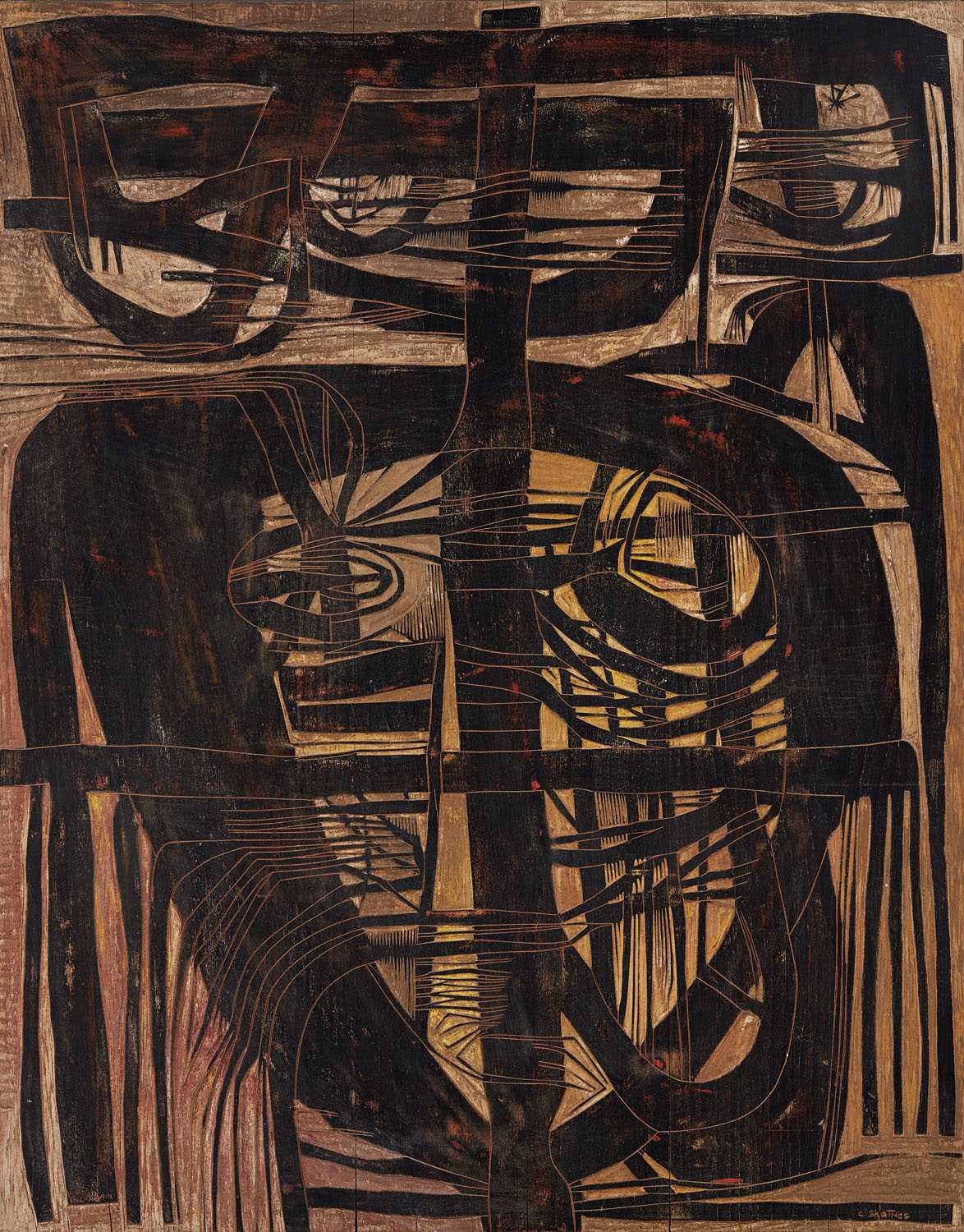
African Figures ,
Procedencia :
Exhibited :
Literature :
Notas : The life and artistic practice of Cecil Skotnes was deeply entrenched in Africa. His experience of teaching at the Polly Street school in the heart of Soweto was one that allowed him to see past the blinkered view of white life under apartheid, and exposed him to the day to day issues of township life. For his part, Skotnes brought to the Polly Street school a vision of artfrom Europe – one where art was a lived experience integrated into everyday life. The kind of figures and styles that became iconic in Skotnes’ works were born from an eye not focused on Europe but a vision that showed a deep understanding of African art forms; a visceral consciousness seen in the highly conceptualised portraits and depictions of people – their emotional states moulded into a new form. This panel, African figures, is signed with a very small, precise signature – seldom seen beyond the period where Skotnes and Egon Guenther were breaking the mould and challenging a Eurocentric South African art community with the formation of the Amadlozi Group. Amadlozi, meaning ‘spirit of our ancestors’, was selected as a name to signal the group’s interest in an African identity, exemplified by Skotnes’ iconic depictions of Shaka. The precision of Skotnes’ forms is remarkable in the 1960s and is reflected in the prints he made in collaboration with Guenther.
The print block became liberated into its own form – an artwork in itself. The delicate fine lines that are almost unimaginably difficult in this technique show a mastery that is synonymous with their collaborative works during this period. African figures was in all likelihood made in the mid-1960s and demonstrates the style, execution and subtle, muted earthy palette of many of the works produced under Guenther’s influence. It is strikingly similar in palette and execution to another work known as African figures, from 1965, which has to date fetched the highest price for a work by Skotnes at auction. In the many hundreds of works in his oeuvre it is rare to find a work with this degree of finesse. It may be compared to the important later work, The Legend of the Judean War (1984), in this work Skotnes adopted a more definitively carved, tougher form – albeit with a more vibrant colour palette. Here one sees an almost brutalist consciousness which is very different from the early work.
Mary-Jane Darroll
Condition_report :