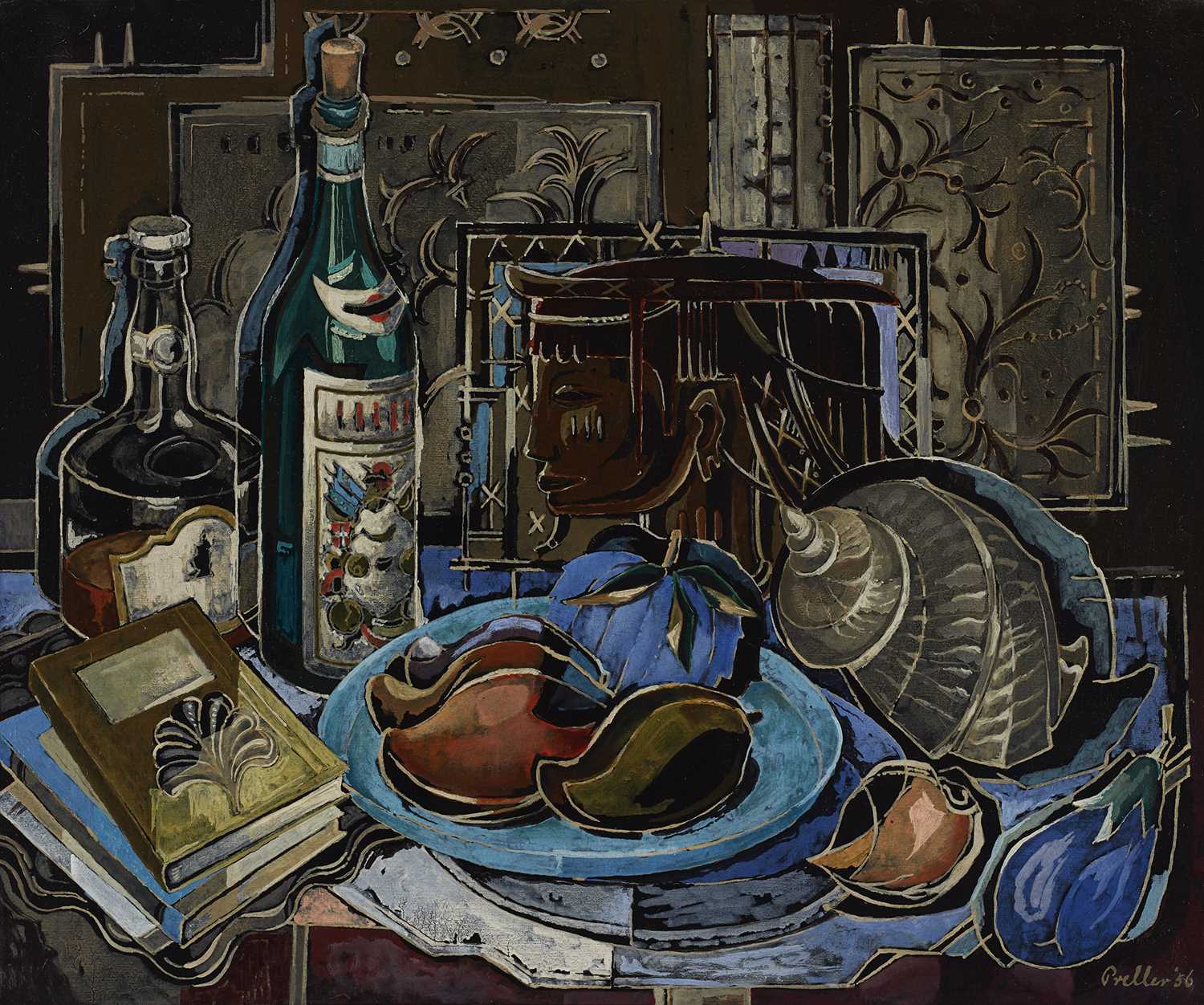
The Blue Plate ,1956
Provenance :
Exhibited : Lidchi Gallery, Johannesburg, Alexis Preller, 13 to 24 March 1956.
Literature :
Notes : Alexis Preller was in many ways an artist torn between two impulses: in one thread his work is cosmic, fantastical, visionary; in another observational, familiar, acute. What often tied the threads together was his ubiquitous ‘household gods’ concept. These talismanic domestic objects were various, brought together from his travels, as gifts from friends and family, or taken from his garden and immediate surrounds.The ways in which these objects weave through his artistic output are very interesting. Often they appear in a painting to tie a grand theme or subject to a more prosaic and familiar grounding. At other times they provide a sacramental character to scenes depicted in his paintings, providing the markers of a visionary space. This reorientation of the meanings inherent in everyday objects, a recasting of the relationships between objects and their significance, became one of the hallmarks of Preller’s work. Even the standard subjects of still life painting generally, such as fruit, took on an overdetermined symbolic nature in his work. Good examples of this are the intaglio apples of his later career.
In this work, a decidedly domestic still life tableau is given a typically Prelleresque signature by the addition of symbolically charged items from the artist’s studio. The blue plate in the mid-foreground contains pieces of fruit in a concession to standard still life convention. In the bottom right of the frame an impossibly blue aubergine echoes the blue of the plate, reminding us of the artist’s mastery of and innovation with colour. The range of other domestic objects, including the bottles dominating the left mid-ground of the frame, and the pile of books whose identity is carefully elided, beautifully establish the context of the work as an accomplished still life. But other elements make it a Preller still life. The stylised screens in the background, and particularly the sketched profile figure in the midground, are quintessential touches by the artist. The audacious inclusion of one of his own works in this painting makes it unusual – the profile figure would reappear many times over the years, and featured in a very similar composition to the one rendered here as a still life object, in the two paintings entitled The Young King, a year later than this exquisite work.
James Sey
Condition_report :