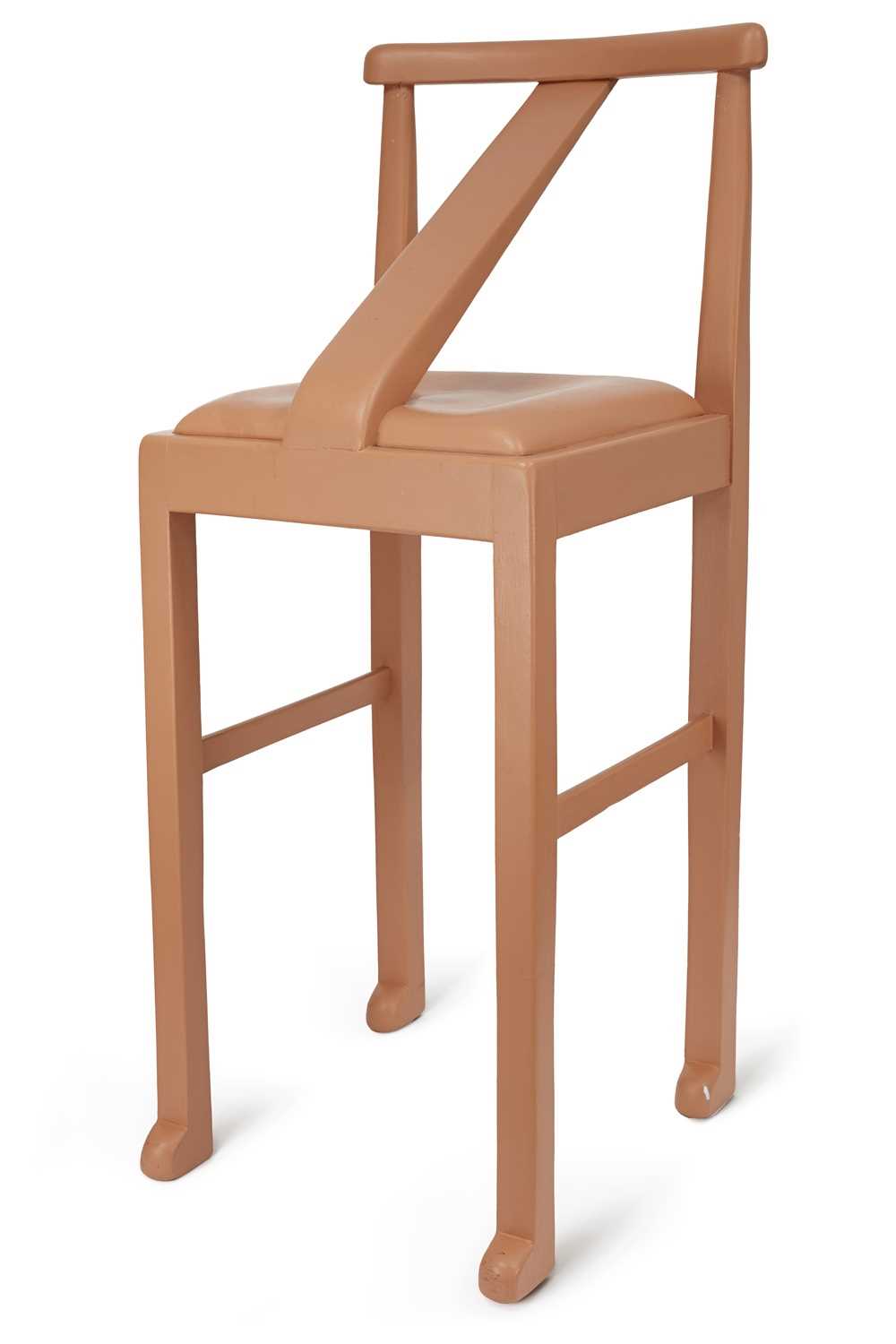
Chair ,
Provenance : Private collection, Johannesburg.
Exhibited :
Literature :
Notes : Peter Schütz used chairs as metaphors. He drew on both European and African traditions where chairs marked particular status and occupations. Fiona Rankin-Smith cites Schütz’s view that the chair, beyond its use function “also embraces societal and cultural aspects” and that he uses “this to comment on certain human situations”(2015:63). As chairs are used by particular people to mark out their identities and status, as where a professor occupies a ‘chair’, or a monarch a ‘throne’, or a family head a particular seat, the possibilities for exploration are fertile ground for Schütz’s humour. Office furniture seems to be the particular focus of these two works. Many of Schütz’s chairs are discarded objects with hidden histories, transformed by various additions into the metaphors of which he speaks. Melted Chair is in a style common in office furniture in the 1950s and early 1960s, but the cushioned seat, which Schütz carved as if melting away down one leg has rendered it uncanny and unusable. He achieved the same effect in Chair by extending the legs, with little boot-like ends so that it is extremely tall, and by placing a band across the upper section obstructing the seat. These chairs, both of which prevent any sedentary activity, thus perform as metaphors for people and their unseated status. Melted Chair suggests previous activity that is now erased and disguised under the smooth finish of the blue gray paint. Chair, in its grandiose elevation invokes an overstated sense of status.
Anitra Nettleton
[1] Peter Schutz notes cited by Fiona Rankin-Smith: “The Wits Art Museum Collections: Tracing African influences in the work of Peter Schütz” in Nettleton, A. (ed). (2015). Peter Schütz: An Eye on the World. Johannesburg: Wits Art Museum, pp.59-78.
Condition_report :