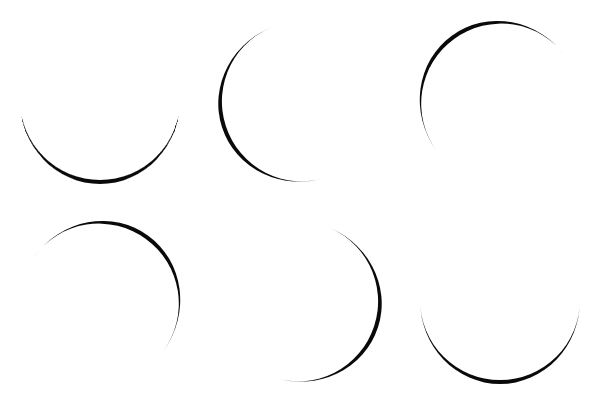
Ahmed Moustafa , Egyptian B. 1943 Infinite Interior Oil And Watercolour On Hand-Made Paper
Provenance :
Exhibited :
Literature :
Notes : Ahmed Moustafa's magnificent examples of modern calligraphy are a commemoration of God's divinity. Beginning his training grounded in western aesthetic tenets, it was only later in his career that Moustafa discovered the power, beauty and indeed, mathematical perfection, of his native language as an art form. Taking the rhombic point or 'dot' as a point of departure for any letter form, Ahmed Moustafa resurrects the calligraphic doctrine of the tenth century scribe Ibn Muqla, who was the first exponent of proportioned script. This dot, the cube, carries enormous weight in calligraphic practice as it is the building block on which the balance and harmony of the entire structure rests. It is the dot itself, as much as the space around it that creates a visual accord so pleasing to the observer. In utilising classical Arabic poetry or Qur'anic verse as his subject matter, Moustafa's work impacts on both a cerebral and visual level. The meaning of the inscription is as important, to the artist's mind, as the way in which they are represented on the paper. The words are as much a celebration of God's message as the mathematical perfection of the script. In this case the inscription that forms all the planes, both interior and exterior reiterate the unity of God: "Say: He is the One god: God the Eternal, the Uncaused Cause of All Being. He begets not, and neither is He begotten; and there is nothing that can be compared with him." The Qur'an, Surat al Ikhlas, CXII.
Condition_report :