This is the rating and price for Ca. 945 - 332 B.C. Third Intermediate Period To Late Period., 1994
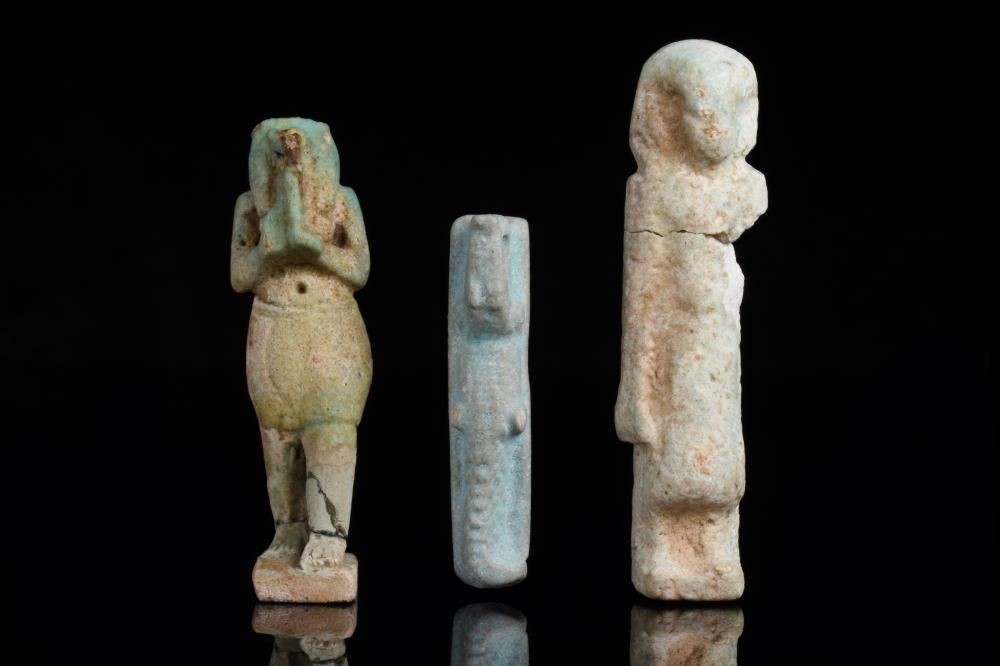
Description : Ca. 945 - 332 B.C. Third Intermediate Period to Late Period. Egyptian. A group of Egyptian faience antiquities including a composite /statuette of the torso of the Ibis-headed god Thoth who was a patron of scribes and the recorder of the decision of the deceased in the weighing of the heart ceremony in the Book of the Dead. Richly formed in a dark green glazed faience upon a trapezoidal base. Arms raised at the chest holding writing implements. In the center, a long light blue faience composite amulet of the crocodile god Sobek with his long stretched tail and scales depicted moulded to a high standard. A suspension hole through the head to provide the attachment to a necklace or bracelet. Lastly, a shabti figure formed of glazed faience of an overseer, one hand saw outretched at his side. In ancient Egypt, amulets were believed to have positive properties, that magically would bestow upon their owner and wearer. Throughout Egypt's long history, people wore amulets to avoid disease and other forms of misfortunate. Amulets were used as a magical talisman to ensure the well-being and good fortune. Amulets were made in huge abundance and were inexpensive to most when crafted in faience, which was available to nearly everyone. However, other forms of amulets were made of expensive materials such as gold, silver, and semi-precious stones, which were believed to be more durable and everlasting. Aside from wearing amulets during daily life for health and well-being, they were also used for the dead and were placed on the mummy or inside the bandages of the deceased. Amulets were often small, varying between mm to a 2 1/2 -. Pectoral scarabs and other forms of amulets were larger than the average funerary amulet. These funerary amulets would provide magical properties to the deceased, ensuring an eternity of good health and well-being. A few examples of popular amulets were the heart scarabs, usually larger than the average naturalistic scarabs. These were usually formed of rich hardstone with a chapter from the book of the dead asking its heart not to tell of his or her misdoing through life, during the weighing of the heart ceremony. The heart would be placed on the scales and weighed against the Maat feather. This is where our modern-day saying light as feather derived. The Ib heart, an amulet in the shape of a heart, was believed to hold the deceased essence and thought and feeling. The Four Sons of Horus plaque amulets used to protect the organs of the deceased, these were Imsety, the human-headed deity protector of the liver, Duamutef, the jackal-headed deity, protector of the stomach, Hapi, the baboon headed deity, protector of the lungs, and finally, Qebehsenuef, the falcon-headed deity, protector of the intestines. These were placed lovingly in the bandages to protect the deceased organs for use in the afterlife. Amulets of similar forms see Carol Andrews, Amulets, 1994. William Flinders Petrie, Amulets, 1914. Provenance: From a London private family collection, formerly acquired on the UK art market in the 1960s - 1970s, then passed by descent. Size: L:Set of 3, 45-65mm / W:44489mm , 20g
Price: 0.00 USDIt's free to register now to view!
Estimate (low-high) : 400 GBP-800 GBPIt's free to register now to view!
About the lot N° 233 Title : Ca. 945 - 332 B.C. Third Intermediate Period To Late Period., Period : 1994 Apollo Art Auctions, auctioneer, London, UKIt's free to register now to view! Sale title : ANCIENT ART AND ANTIQUITIES Sale date : 21 Nov 2021It's free to register now to view! Sale Reference : Live Sale