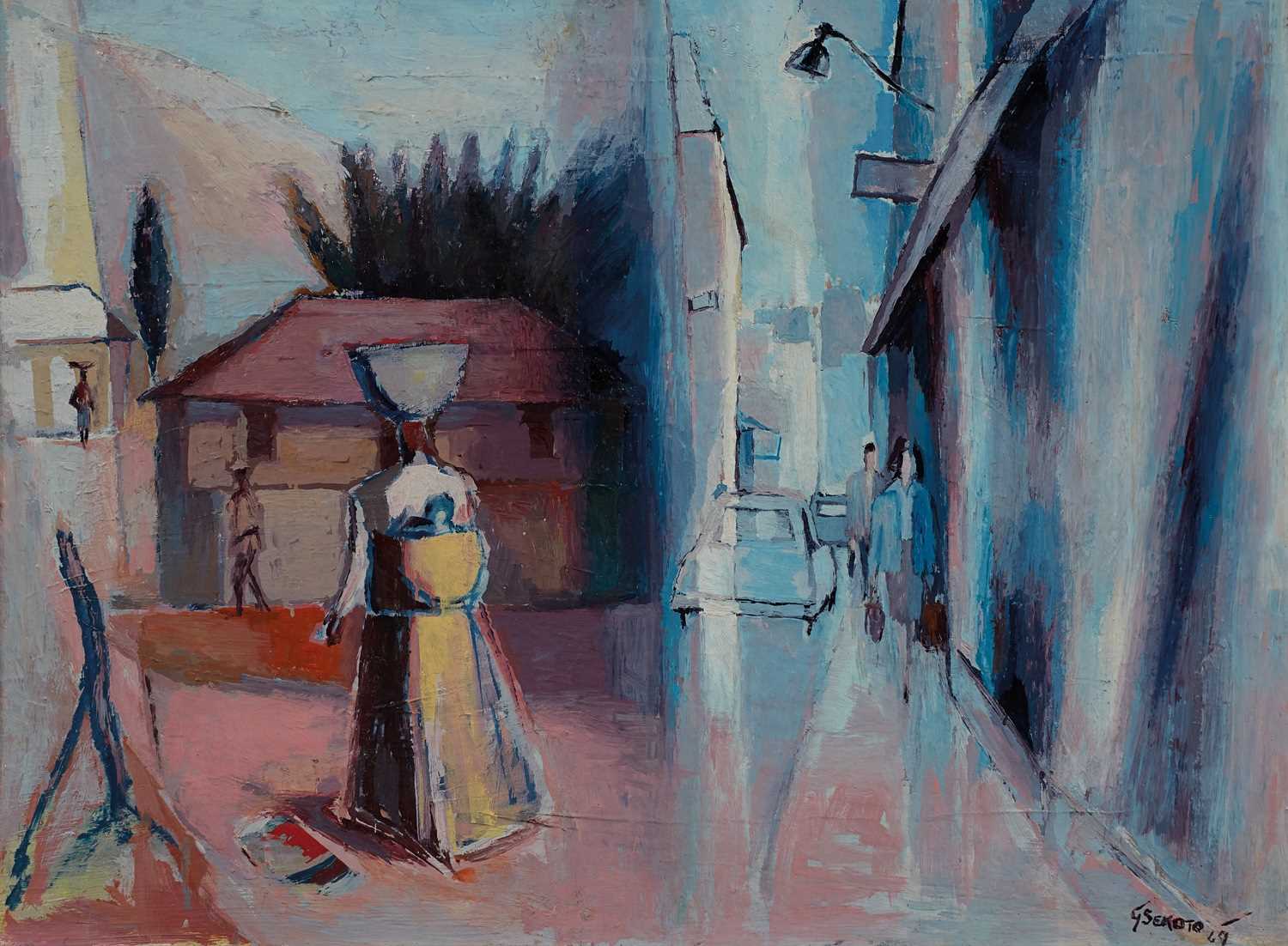
The Two Worlds ,1969
Herkunft :
Exhibited :
Literature :
Anmerkung : Gerard Sekoto is undoubtedly one of the most important black South African modernist artists of the mid-to late-twentieth century. While his style is widely recognised as a pioneering form of urban black social realism, it also demonstrates his commitment to a dynamic and imaginative visual interpretation of his subject matter. Born in Mpumalanga, he subsequently lived in Sophiatown, in District Six in Cape Town, and in Pretoria, before going into self-imposed exile in Paris in 1947. Sekoto’s travels around South Africa were tied up with his decision to become a full-time artist. He relocated from his teaching position in what is now Limpopo to pursue his career by settling in the legendary Sophiatown, near Johannesburg, in 1938. While living there he met Joan Ginsberg of the prominent Gainsborough Gallery, as well as the artists Judith Gluckman and Alexis Preller, the latter also in the infancy of his career.As he met and mixed with an artistic community, and began to show his work, the obstacles to the artistic advancement of black artists set up by the colonial administration of the country at the time became more and more frustrating. With the advent of high apartheid with the ascent to power of the National party in the offing in 1948, Sekoto decided to seek exile in Paris in 1947. He earned a precarious living there, partly as a bar-room jazz pianist, but continued to paint.His life in Paris was enlivened by his involvement, through the 1950s, with various pan-African movements and personalities in Europe, and was punctuated by further travel, most influentially to Senegal in 1966-1967, where he was invited by the poet and statesman Leopold Senghor, and where part of his time was spent in the relatively remote village of Casamance. The current work is clearly an unusually composed reflection on the dichotomous life the artist was leading – from the rural idylls of his visit to Africa, and nostalgic imaginings of his own homeland in South Africa depicted on the left of the picture plane, to a distinctly white and urban reality – perhaps Paris, perhaps apartheid South Africa – on the right. Sekoto never did return to the land of his birth, and died in Paris in 1993.
James Sey
Condition_report :