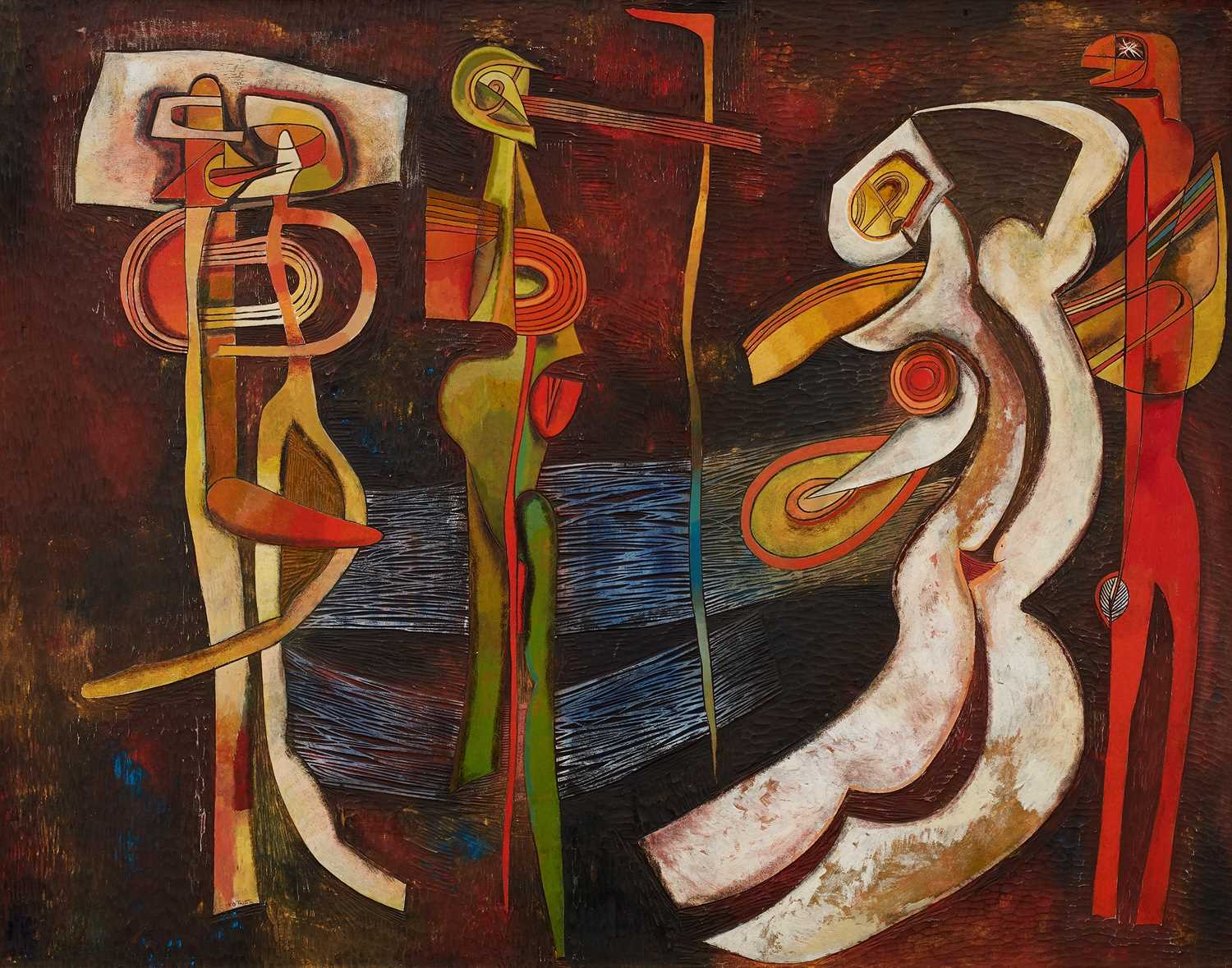
The Legend Of Gilgamesh ,
Herkunft :
Exhibited :
Literature :
Anmerkung : Shortly after his marriage to Thelma Carter in 1951, Cecil Skotnes and his new wife lived for nine months in London. It was there at the British Museum that Skotnes saw the vast colonial collections of Egyptian, Assyrian, pre-classical and African art that would have a profound influence on the rest of his artistic career. This carved, incised and painted wood panel is clearly borne out of that influence – depicting an episode from the Sumerian epic, Gilgamesh, widely regarded as the earliest surviving work of literature and dating back to c2100 bc. The Epic of Gilgamesh had provided the inspiration for a series of wood panels that Skotnes had produced for a commission from winemakers KWV in 1977. For the KWV commission, titled The Epic of Gilgamesh/ The Origin of Wine, Skotnes had focused on the second half of the epic poem in which the protagonist, Gilgamesh the king of Urak, goes in search of the secret to immortality following the death of his beloved friend Enkidu.
Along the way he encounters Siduri, the goddess of wine who tells him that immortality is impossible but that man should eat, drink, enjoy the good things in life and make others happy – a philosophy that Skotnes firmly embraced in his own life. While the link between the KWV commission (which is on display at the Laborie wine farm in Paarl) and this piece is predominantly in the title and not in the imagery, there is a delicacy of detail, verve, kinetic energy and use of colour that connects the work to much of Skotnes’s later period wood panels. In particular, the use of greens, blues and yellows, places The Legend of Gilgamesh within the period after the 1970s, when Skotnes relocated from Johannesburg to Cape Town and the difference in light between the two places began to be expressed by the artist in his work through increased use of brighter and more diverse colours taken from his new surroundings. This work formed part of the personal collection of Goodman Gallery founder Linda Givon, who was a staunch supporter of Skotnes from 1966 when she opened her gallery, until the artist’s death in 2009.
Tymon Smith
Condition_report :