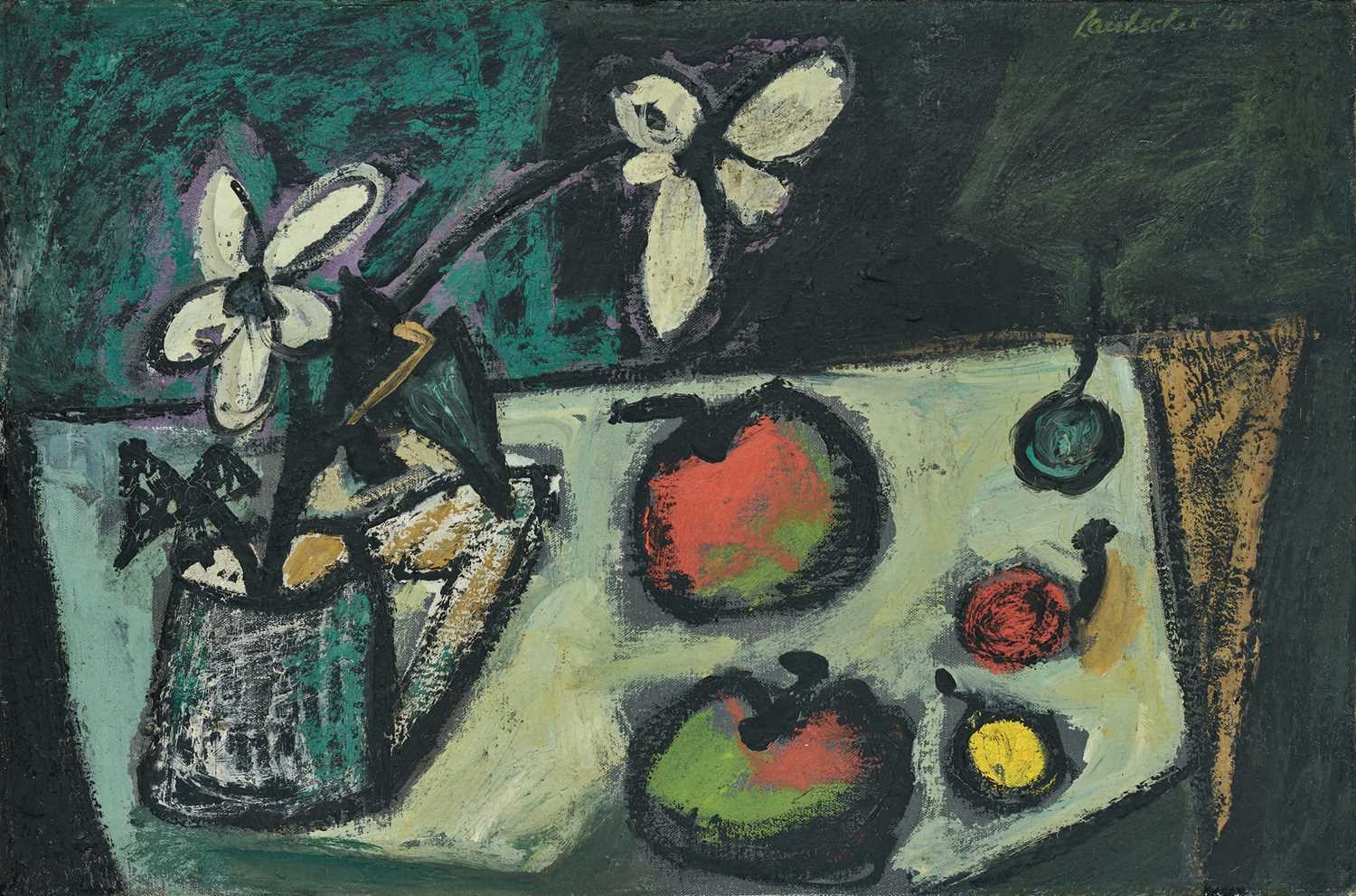
Still Life With White Flowers ,1948
Herkunft : [Propriété non datée]
- Private collection, Johannesburg
- SMAC Art Gallery, Stellenbosch
Exhibited : SMAC Art Gallery, Stellenbosch, Erik Laubscher: A Major Retrospective Exhibition, 5 December 2009 to 25 February 2010.
Literature : Fransen, H. (2009). Erik Laubscher: A Life in Art. Stellenbosch: SMAC Art Gallery, illustrated in colour on p.13.
Anmerkung : There is an unfinished painting depicting a wine glass on the reverse.
Erik Laubscher painted these two exquisite still-lifes in London during his time at the Anglo-French Art Centre (AFAC). The young, zealous artist arrived in England in the spring of 1948, and after attending art classes with painter Frank Slater, decided to enrol at the Centre to further study the various artistic approaches of the new Modern movements. This académie libre offered an exciting environment for Laubscher, which exposed him to lively debates about art and exchanges of various creative and theoretical ideas.
One of his lecturers at the AFAC was the Polish abstract painter Jankel Adler who settled in London after fleeing Nazi Germany. A key figure in the 20th century avant-garde, Adler himself was strongly influenced by Cubist painters Fernand Léger and Pablo Picasso, and his teachings and own art made a formative impact on Laubscher and the early stylistic development of his work – evident in many of the paintings Laubscher produced during this time.
Laubscher returned to still life painting as a subject throughout his long career. For him, the still life presented a means to explore, at once, all the essential elements of art. Unlike his landscape paintings, Laubscher’s still life’s are autobiographical – they are a reflection of a specific time in his life, emotion and state of mind, but more importantly, they stand as icons of his various artistic achievements. Painted in 1948, Still Life with White Flowers and Still Life with Black Bowl form part of a significant body of work that marks the beginning of Laubscher’s lifelong exploration of new ways of seeing.
Post-cubist in style, each painting depicts an arrangement of modest objects; a jug with two white flowers, a bowl with apples, loose cherries (most probably from his studio in Abbey Road) on a cloth loosely laid out on a table-top, rendered in simple shapes – some with stronger angular forms – in bold bright colours. Like Adler, he adds strong black lines and dark colouring for visual impact and contrast. The scenes are beautifully stylised on small formats, and the artist’s brushwork and handling of paint is exceptional.
Laubscher lived and studied in London for just over two years, returning to South Africa in 1949. Paintings from his ‘London Period’ – predominantly still lifes – are extremely rare and remain highly sought after.
Condition_report :