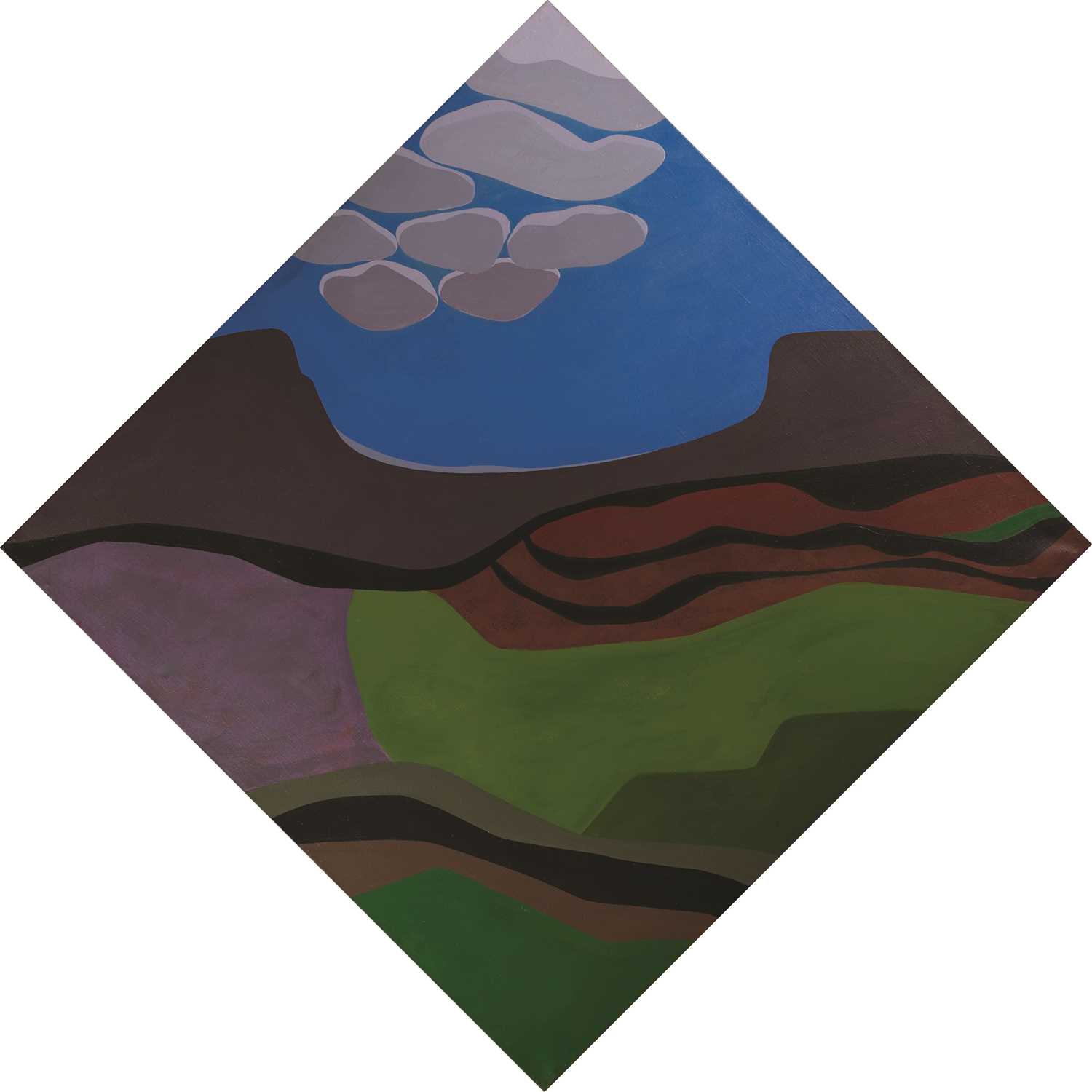
Near Riebeek Kasteel ,1968
Herkunft :
Exhibited :
Literature :
Anmerkung : The well-known Cape Town art dealer Joe Wolpe once remarked that Erik Laubscher ‘produces the sort of abstract painting that can make sense to everyone. People like it because it is simple and forceful and it really means something’.1 Laubscher is recognized as one of the leading and most dominant figures of the generation of post-war Cape painters working in abstraction during the 1960s, and it is his unique hard-edge portrayals of the countryside in the Western Cape in particular, that left a lasting impression and for which he is most renowned. Near Riebeeck Kasteel is another hallmark of Laubscher’s hard-edge landscapes, showing the artist translating the structural elements of this area onto canvas in a compositional arrangement of simplified forms with flat planes of colour. The work was painted in 1968, two years after Laubscher visited the United States where he discovered the works of the Californian/ West Coast hard-edge painters and the New York School. This period saw him painting on larger formats and using acrylics. Riebeek-Kasteel is one of the oldest towns in South Africa, situated 80 km north-east of Cape Town. In this painting, Laubscher shares an intimate view of the valley nestling on the slopes of the dramatic Kasteelberg. The surrounds are wheatlands, vineyards as well as olive groves, and there are some clouds in the sky. He presents the scene on a shaped canvas for visual effect, which also shows his concern for design and structure in composition. It is seemingly simple, with an emphasis on the flatness of the surface, clean edges and shaped areas of colour. However, there is great power in its simplicity. The sense of depth and space present in this work pulls the viewer in, almost forcing one to pause, look carefully and appreciate the scene. In his own words: ‘I wanted to create paintings that also gave the feeling that it wasn’t just one little picture … The painting has to evoke the monumental feeling that really does exist in Africa’.2
Marelize van Zyl
Condition_report :