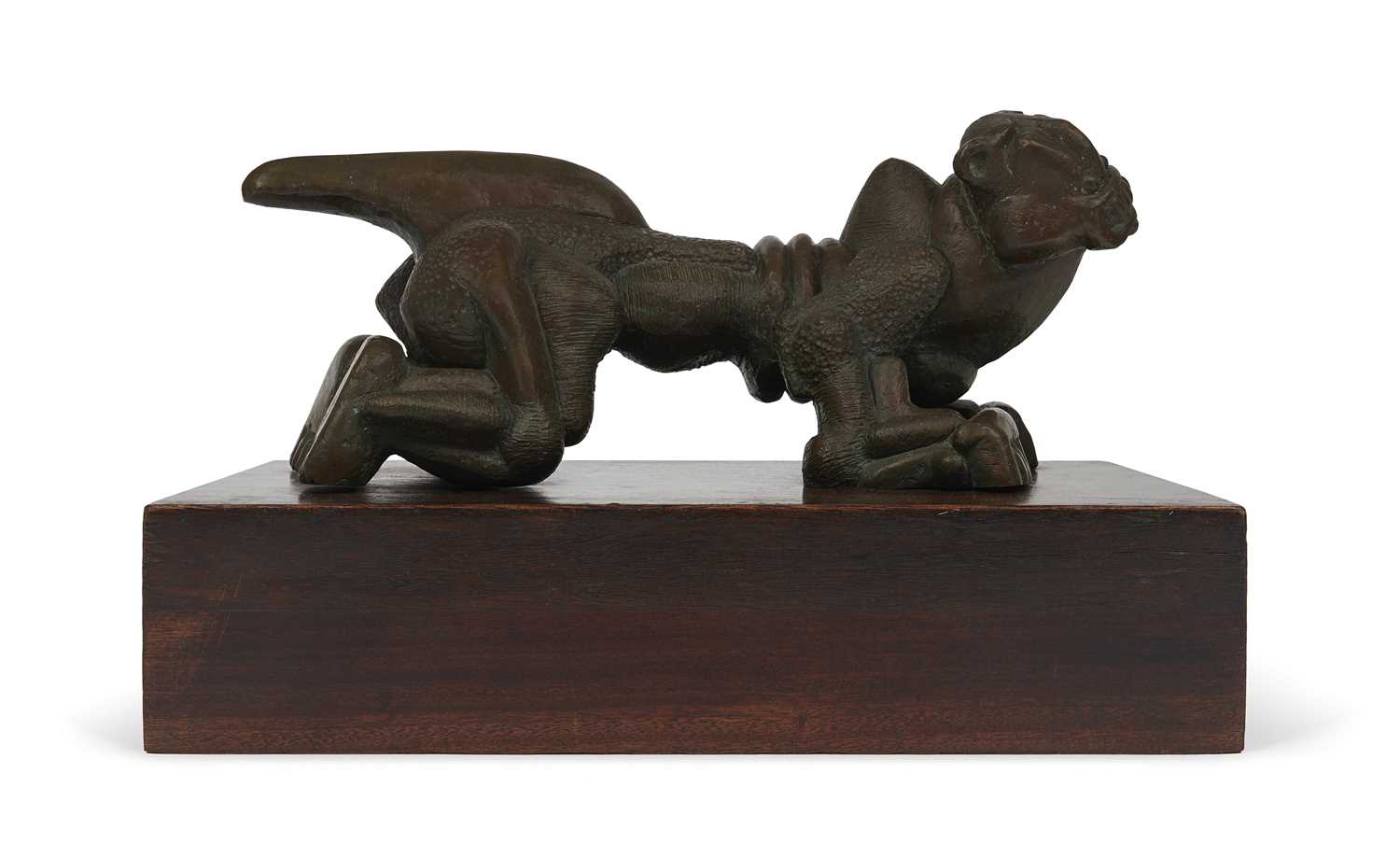
Leopard ,1966
Literature : Watter, L., Toerien, H. and Duby, G. (eds.). Our Art 3, Sydney Kumalo. Pretoria: Lantern, illustrated on p.72 where it is incorrectly titled Leopard II.
Anmerkung : Sydney Kumalo is an alumnus of the historic Polly Street Art Centre where he studied under Cecil Skotnes from 1953, and with sculptor Edoardo Villa in 1958–59.Their respective influence is palpable in Kumalo’s approach to form. This bronze sculpture titled Leopard rings with a register, of his lifelong fixation with both the human form and that of beasts – real and imagined. He often created work that fused the two in abstracted motifs. Abstraction allowed Kumalo the technical licence of going into mythology. His treatment of the leopard subject is an example of this. He renders the beast not as we know it, but as it may appear in folklore or myths. This is not the leopard of nature nor the zoo, but of nightmares and folktales. In classic Polly Street style it wrestles with incorporating both African and European traditions of sculptural sensibilities.Kumalo often returned to the same motif multiple times to reimagine its form. This sculpture titled Leopard is one of a few “leopards” he created with variation in style and composition. This “Leopard” was cast by Egon Guenther in 1966 in an edition of 10. Guenther had cast another larger Kumalo leopard, which he called Black Leopard, in 1961/1962).It can be compared with another less stylised and less fanciful leopard bronze sculpture titled The Leopard cast in 1961, which sits in the Standard Bank corporate collection.Kumalo approach was to model his sculptures in terracotta and cast them in bronze. This gave his works a plasticity hard to achieve by other means. The exaggerated muscle curvature and the rhythm in the naïve and childlike approach to proportions on this this leopard betrays the clay beginnings of the work.
Percy Mabandu