Ahmed Cherkaoui (1934-1967) Les Miroirs Noirs Vii
Herkunft : [Propriété non datée]
- Property from a private collection, FranceProperty from a private collection, SpainAcquired directly from the artist by the above 'This is not the hard-edged abstraction championed by other well-known Moroccan modernists at the time such as Mohamed Melehi
- Instead, Cherkaoui's work here and throughout his career retains much more of the hand of the artist
- He was an early instigator to a broader movement in Morocco during the short span of his career between the late 1950s and 1967, when he died abruptly from complications from appendicitis
- Despite the short length of his career, artists and the arts discourse in Morocco throughout the 1960s and 1970s came back repeatedly to questions Cherkaoui had begun to pose before his early death
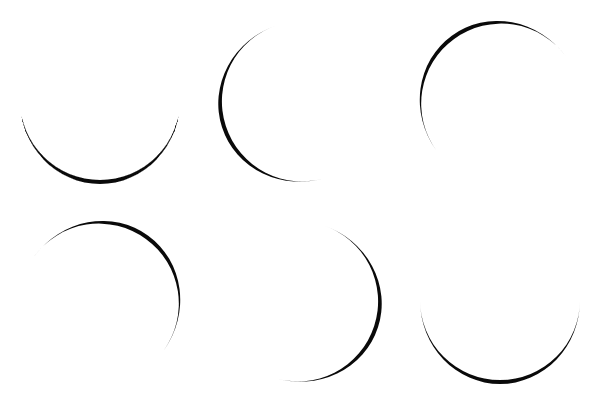
- Cherkaoui was one of the first artists to attempt to ground abstraction in signs and symbols, actively confronting the duality of and distance between Morocco and Europe as can be seen in his 1965 painting Les Miroirs Noirs VII (The Black Mirrors VII)
- If the resolutely flat plane, visible brush strokes, and loose gestural abstraction call to mind the Paris School, the luminous earth tones and central symbol still link back to Morocco
- For an artist that felt himself continually torn between France and Morocco, it was in his work that he was able to create an interstitial space
- The elements of the painting are not precisely locatable to a discreet national body yet still gesture to his multiple geographic ties, creating instead a new blend and bridging the distance between the two on canvas
- Trained in calligraphy in Qur'anic schools in Morocco, Cherkaoui left for Paris to study graphic design at the École des Métiers d'Art in 1959
- Despite his interest in design, it was during his time in Paris that he began focusing more on painting and began frequenting the atelier of painter Jean Aujame
- Influenced by the work of Paul Klee and Roger Bissière, Cherkaoui began working with abstraction
- Like many artists of his generation in Morocco, it was while he was abroad, studying in Warsaw at the School of Fine Arts, in 1961, that Cherkaoui became invested in a closer look at his own background and cultural heritage
- This led him in part towards experimentation with new materials, such as his series consisting of paintings on jute and collages that allowed him to expand on the boundaries of more academic painting.1 It was upon his return to Morocco after that year that he began exploring more closely the signs and symbols culled from local visual culture that would go on to populate his visual language.2 In many ways, this is an evocative moment for a career that was so intensely rooted in Morocco yet primarily articulated abroad
- After multiple years abroad, Cherkaoui came home only to leave again to forge a career in France
- By 1965, the year in which he painted Les Miroirs Noirs VII, Cherkaoui was at the height of his career and working in France
- That same year, Gaston Diehl, the highly influential director of the Cultural Exchanges at the French Cultural and University Mission, writes, again in a text reproduced in L'Opinion: 'Given that our universal contemporary art has been so often criticized by vocation and by taste to be without particular roots, let us rejoice in front of the oeuvre of an artist that is not afraid to affirm his personality andhis origins.
- That he plunges into a long ago past does not keep him from living in the present or placing himself there [in the present] with vigou
Exhibited :
Literature :
Anmerkung : This lot is subject to the following lot symbols: *
Condition_report :